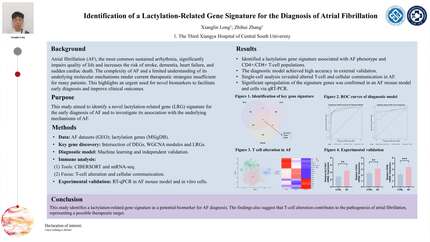
Identification of a lactylation-related gene signature as the novel biomarkers for early diagnosis of atrial fibrillation
European Heart Journal


Abstract
Atrial fibrillation (AF) is the most common sustained arrhythmia, significantly impacting quality of life and increasing the risk of stroke, dementia, heart failure, and sudden cardiac death. The complexity of AF, coupled with limited understanding of the molecular mechanisms driving its onset and progression, makes current rhythm control strategies insufficient for some patients. This underscores the need for novel biomarkers that can facilitate early diagnosis and improve patient outcomes.
This study aims to identify lactylation-related genes (LRGs) associated with AF, evaluate their potential as biomarkers for early diagnosis, and explore the underlying mechanisms of atrial remodelling through histone lactylation and immune cell involvement.
We analyzed AF-related gene expression datasets from the GEO database, using differential gene expression analysis and Weighted Gene Co-expression Network Analysis (WGCNA) to identify key genes and co-expression modules. Lactylation-related genes from the MSigDB database were examined for their association with AF. Unsupervised consensus clustering was employed to categorize AF into subtypes, and machine learning models were developed for diagnostic purposes. Immune cell infiltration was assessed with CIBERSORT, focusing specifically on T cell activation-related LRGs.
Three LRGs (CD46, SLC16A1, COG3) were found to be significantly expressed in AF. These findings were validated through in vitro experiments using primary cardiomyocytes derived from Sprague-Dawley rats, confirming the relevance of these genes in AF pathology.
Our study identifies LRGs as potential biomarkers for the early diagnosis of AF and provides new insights into the mechanisms of atrial remodelling mediated by histone lactylation and immune cell activation, particularly T cells. These findings may guide future diagnostic and therapeutic strategies for AF.


You may be interested in