Prognostic value of epicardial adipose tissue parameters assessed by computed tomography in predicting atrial fibrillation ablation efficacy
European Heart Journal


Abstract
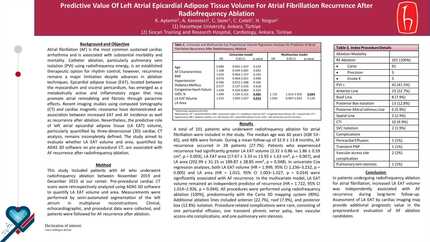
Recent studies indicate that epicardial adipose tissue (EAT) significantly influences the pathophysiology of atrial fibrillation (AF). An increase in EAT volume may correlate with a higher recurrence rate of arrhythmias following ablation procedures. Emerging data suggest that computed tomography (CT) measurements of EAT attenuation reflect localized inflammation, which may influence the efficacy of ablation. However, strong evidence supporting its clinical significance remains limited.
This study aims to evaluate the prognostic value of EAT parameters measured using CT in predicting the efficacy of the AF ablation procedure.
Fifty-two patients with paroxysmal AF undergoing first-time, single-shot pulmonary vein isolation - either via cryoballoon or pulsed-field ablation - were enrolled. Prior to the procedure, each patient underwent a comprehensive evaluation, including contrast-enhanced cardiac CT, clinical assessment, and echocardiographic examination. Total-EAT was defined as a tissue surrounding the heart, bordered by the pericardial sac and extending to the pulmonary artery bifurcation, with attenuation values ranging from −200 to −50 Hounsfield units (HU). LA-EAT specifically referred to the EAT localized around the left atrium. The volume and mean attenuation within these regions were measured. Arrhythmia recurrence was defined as documented AF or atrial flutter lasting more than 30 seconds during the follow-up period, excluding the blanking period (first 3 months).
During a median follow-up of 14 months (Q1-Q3: 10-21 months), the procedure success rate was 57,69%. Patient characteristics are presented in Table 1a, and risk factors for arrhythmia recurrence are summarized in Table 1b. Figure 1 presents EAT attenuation and volume differences between the recurrence and no-recurrence groups. Conclusions: The enhanced inflammatory activity of EAT, demonstrated by increased attenuation on CT, correlates with the reduced efficacy of the ablation procedure in individuals with paroxysmal AF.
Contributors


K Krauz
Author
D Rodkiewicz
Author
E Kozluk
Author
A Piatkowska
Author
Z Zalewska
Author
M Buksinska-Lisik
Author
A Mamcarz
Author
You may be interested in