Combination of extracellular volume and significant valvular abnormality has a significant influence on the prognosis in dilated cardiomyopathy and heart failure with reduced ejection fraction
European Heart Journal


Abstract
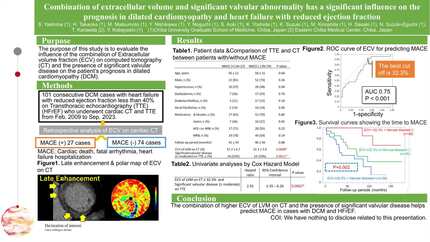
Transthoracic echocardiography (TTE) is a traditional examination to evaluate cardiac function, such as ejection fraction or the presence of valvular disease. Cardiac computed tomography (CT) helps screen coronary artery stenosis in cases with dilated cardiomyopathy (DCM). Extracellular volume fraction (ECV) analysis has recently been eligible for CT (Figure A), and it is known as a new parameter of myocardial fibrosis.
The purpose of this study is to evaluate the influence of the combination of ECV of LVM on CT and the presence of significant valvular disease on the patient’s prognosis in DCM.
We analyzed 101 consecutive DCM cases with heart failure with reduced ejection fraction (HFrEF) who underwent cardiac CT and TTE. All patients had a lower left ventricular (LV) ejection fraction (LVEF) of less than 40% on TTE.
Major adverse cardiac events (MACE) occurred in 27 cases (27%). The patients with MACEs had a higher prevalence of moderate or severe valvular disease on TTE (52% vs. 19%, P = 0.0011) and an increased ECV on LVM on CT (37.2 ± 6.7 vs. 32.2 ± 3.6%, P = 0.0008) compared to the others (74 cases). Based on the receiver operating characteristics curve analysis, the best cutoff value of ECV on LVM to predict MACE was 32.3%. All patients were classified into 3 groups; 26 patients with ECV ≥32.3 and significant valvular disease, 39 patients with ECV ≥32.3 or significant valvular disease, and 36 patients had neither ECV ≥32.3 nor significant valvular disease. In each group, 14 of 26 patients (53.9%), 11 of 39 patients (28.2%), 2 of 36 patients (5.6%) had MACE (p<0.01). Based on the Kaplan-Meier analysis, the patients with ECV ≥32.3% and significant valvular disease had significantly higher MACE compared to other groups (p=0.002) (Figure B). ECV ≥32.3 and significant valvular disease was the significant predictor of MACE based on the univariate Cox proportional hazard model (Hazard ratio 2.91, 95% confidence interval 1.35 – 6.26, P = 0.0062).
The combination of higher ECV of LVM on CT and the presence of significant valvular disease helps predict MACE in cases with DCM and HFrEF.
Contributors

H Takaoka
Author
M Matsumoto
Author
Y Nishikawa
Author
Y Noguchi
Author
S Aoki
Author
K Yoshida
Author
K Suzuki
Author
M Kinoshita
Author
H Sasaki
Author
N Suzuki-Eguchi
Author
T Kanaeda
Author
Y Kobayashi
Author
You may be interested in