Long-term prognostic value of residual lipid burden in acute myocardial infarction: a three-vessel optical coherence tomography study
European Heart Journal


Abstract
Coronary artery lipid accumulation is indicative of atherosclerosis.
This study aimed to examine the clinical significance and prognostic value of residual lipid burden (RLB) after percutaneous coronary intervention (PCI) in patients with acute myocardial infarction (AMI).
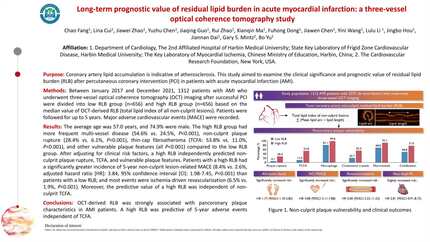
Between January 2017 and December 2021, 1312 patients with AMI who underwent three-vessel optical coherence tomography (OCT) imaging after successful PCI were divided into low RLB group (n=656) and high RLB group (n=656) based on the median value of OCT-derived RLB (total lipid index of all non-culprit lesions). Patients were followed for up to 5 years. Major adverse cardiovascular events (MACE) were recorded.
The average age was 57.0 years, and 74.9% were male. The high RLB group had more frequent multi-vessel disease (54.6% vs. 24.5%, P<0.001), non-culprit plaque rupture (28.4% vs. 6.1%, P<0.001), thin-cap fibroatheroma (TCFA: 53.8% vs. 11.0%, P<0.001), and other vulnerable plaque features (all P<0.001) compared to the low RLB group. After adjusting for clinical risk factors, a high RLB independently predicted non-culprit plaque rupture, TCFA, and vulnerable plaque features. Patients with a high RLB had a significantly greater incidence of 5-year non-culprit lesion-related MACE (8.4% vs. 2.6%, adjusted hazard ratio [HR]: 3.84, 95% confidence interval [CI]: 1.98-7.45, P<0.001) than patients with a low RLB; and most events were ischemia-driven revascularization (6.5% vs. 1.9%, P<0.001). Moreover, the predictive value of a high RLB was independent of non-culprit TCFA.
OCT-derived RLB was strongly associated with pancoronary plaque characteristics in AMI patients. A high RLB was predictive of 5-year adverse events independent of TCFA.
Contributors


You may be interested in