Association of lipoprotein(a) with coronary plaque progression in patients with acute coronary syndrome assessed by optical coherence tomography
European Heart Journal


Abstract
Previous research has established elevated lipoprotein(a) (Lp[a]) as a genetic risk factor of cardiovascular disease, while coronary plaque progression mediated by Lp(a) remains unclear.
This study aimed to investigate the impact of Lp(a) in patients with acute coronary syndrome (ACS) by using optical coherence tomography (OCT).
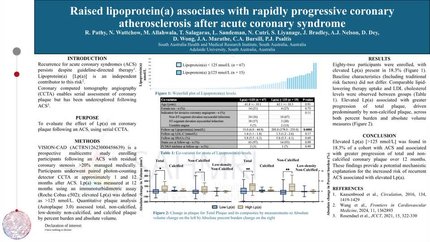
This is a single center, retrospective study. The study included 157 ACS patients with a total of 317 coronary arteries, who underwent OCT of non-culprit lesions both at baseline and at a follow-up interval of 12 months, between January 2017 and December 2021. In this cohort of patients, latex-enhanced immunoturbidimetry was used to measure Lp(a) levels in frozen blood samples stored at -80°C. Patients were divided into normal Lp(a) group [Lp(a) <75 nmol/L, 131 patients with 477 non-culprit plaques] and elevated Lp(a) group [Lp(a) ≥75 nmol/L, 26 patients with 90 non-culprit plaques]. We assessed the relationship between Lp(a) and coronary plaque changes by using the generalized estimation equation and multivariate analyses.
The average age of all enrolled 157 patients was 53.5 ± 11.5 years, with 81.5% (128/157) being male. At baseline, patients with elevated Lp(a) had similar prevalence of thin-cap fibroatheroma (TCFA, 24.7% vs 26.7%, P = 0.698) compared to those with normal Lp(a). After a median follow-up time of 12.3 months, there is a significant reduction in the prevalence of TCFA (24.7% vs 19.5%, P = 0.038) in patients with normal Lp(a), with mean lipid arc (129.3 [104.6, 159.3] ° vs 113.1 [94.9, 143.2] °, P < 0.001) decreased. However, in patients with elevated Lp(a), the prevalence of TCFA (26.7% vs 42.2%, P = 0.004) and macrophage accumulation (92.2% vs 97.8%, P = 0.046) significantly increased as compared to baseline. Of note, 27.8% (25/90) of non-culprit lesions changed from non-TCFA to TCFA (i.e., newly occurring TCFA) in patients in elevated Lp(a) group, compared to 10.1% (48/477) in patients in normal Lp(a) group (P < 0.001). Elevated Lp(a) group also showed a smaller increase in maximum calcification arc (absolute value of change: 7.3 ° vs 47.1 °, P = 0.014) than normal Lp(a) group. After adjusting for covariates (i.e., baseline characteristics, blood lipid profiles, and statins use after discharge), elevated Lp(a) at baseline independently predicted the newly occurring TCFA at median 12.3-months follow-up (odds ratio: 3.42, 95% confidence interval: 1.78-6.56, P < 0.001).
In patients with ACS, Lp(a) ≥75 nmol/L was associated with newly occurring TCFA at 1-year follow-up, and with a more frequent stable-to-unstable plaque phenotype transition. This study offers novel evidence elucidating the role of Lp(a) in coronary plaque progression and emphasizing the importance to manage Lp(a) mediated risk. Plaque composition changes



You may be interested in