Temporal trends in first-line diagnostic testing for heart failure etiology in patients with new-onset heart failure and low pre-test probability of coronary artery disease
European Heart Journal


Abstract
Establishing the etiology of new-onset heart failure (HF) is crucial for appropriate management. Current guidelines recommend diagnostic testing to identify the underlying cause, and the selection of first-line diagnostic testing is often guided by a prior risk of suspected coronary artery disease. How these testing patterns have changed over time remains poorly understood.
To evaluate temporal trend in the utilization of first-line diagnostic tests, specifically cardiac computed tomography (CT), myocardial perfusion imaging (MPI) and invasive coronary angiography (ICA), in patients with new-onset HF over a 14-year period.
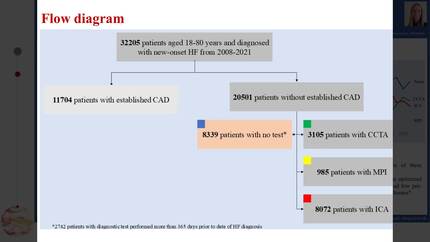
This study used data from the Western Denmark Heart Registry, identifying patients with new-onset HF between 2008 and 2021. Patients with a pre-existing diagnosis of coronary artery disease (CAD) or who underwent ICA at the time of HF diagnosis were excluded. Diagnostic testing (cardiac CT, MPI, or ICA) performed within 365 days before or 365 days after the date of HF diagnosis was considered. The primary endpoint was the choice of first-line diagnostic test.
Overall, 17,954 patients were eligible. Of these, 2944 (16.4%) patients underwent cardiac CT, 375 (2.1%) patients underwent MPI, and 6136 (34.2%) patients underwent ICA. No diagnostic test was undertaken in 8510 (47.4%) patients. Notably, since 2018, the number of non-invasive diagnostic tests (cardiac CT and MPI combined) has exceeded the number of invasive diagnostic tests (ICA).
This study reveals distinct temporal trends in the diagnostic evaluation of new-onset HF in Denmark. While a significant proportion of patients did not undergo specific etiological testing, a shift towards non-invasive modalities, particularly cardiac CT, has been observed in recent years. Further research is needed to understand the clinical implications of these trends and to optimize diagnostic strategies for patients with new-onset HF and low pre-test probability of coronary artery disease. Flowchart Temporal trends
Contributors

L D Rasmussen
Author
J M Sundboell
Author
M Wurtz
Author
K H Kragholm
Author
M Boettcher
Author
S Winther
Author
You may be interested in