Integrating cardiac magnetic resonance imaging and echocardiography to quantify tricuspid regurgitation regurgitant orifice area
European Heart Journal


Abstract
Effective regurgitant orifice area (EROA) is the key parameter to quantify tricuspid regurgitation (TR). However, conventional two-dimensional echocardiography (2DE) proximal isovelocity surface area (PISA) method is limited by geometric assumptions, irregular orifice shapes, and suboptimal inter-observer reproducibility. Cardiac magnetic resonance (CMR) quantifies TR using volumetric method avoids such limits and is more reproducible but cannot directly quantify EROA.
This study aimed to validate the feasibility of a novel integrated approach combining CMR-derived regurgitant volume (RVol) with continuous-wave Doppler (CW)-measured velocity-time integral (VTI) to calculate EROA (EROAintegrated) and compare its performance against conventional PISA-EROA and CMR-derived parameters.
A prospective cohort of 30 patients scheduled for isolated or concomitant tricuspid valve surgery underwent preoperative 2DE and CMR on the same day. EROAintegrated was calculated as RVol/VTI, where RVol was derived from the difference between right ventricular (RV) stroke volume (using CMR cine sequences) and RV outflow tract stroke volume (using phase-contrast imaging). PISA-EROA was measured according to guidelines. TR severity was classified using a multi-parametric algorithm.
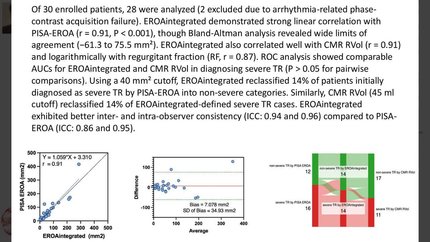
Of 30 enrolled patients, 28 were analyzed (2 excluded due to arrhythmia-related phase-contrast acquisition failure). EROAintegrated demonstrated strong linear correlation with PISA-EROA (r = 0.91, P < 0.001), though Bland-Altman analysis revealed wide limits of agreement (−61.3 to 75.5 mm²). EROAintegrated also correlated well with CMR RVol (r = 0.91) and logarithmically with regurgitant fraction (RF, r = 0.87). ROC analysis showed comparable AUCs for EROAintegrated and CMR RVol in diagnosing severe TR (P > 0.05 for pairwise comparisons). Using a 40 mm² cutoff, EROAintegrated reclassified 14% of patients initially diagnosed as severe TR by PISA-EROA into non-severe categories. Similarly, CMR RVol (45 ml cutoff) reclassified 14% of EROAintegrated-defined severe TR cases. EROAintegrated exhibited better inter- and intra-observer consistency (ICC: 0.94 and 0.96) compared to PISA-EROA (ICC: 0.86 and 0.95).
The combined CMR-Doppler approach provides a feasible, reproducible method for quantifying TR EROA, correlating with conventional metrics. EROAintegrated reclassifies patients graded with either 2DE or CMR alone. This study highlights the nessesity of multimodal imaging to refine TR evaluation. Agreement with conventional EROA Reclassification of TR severity


You may be interested in