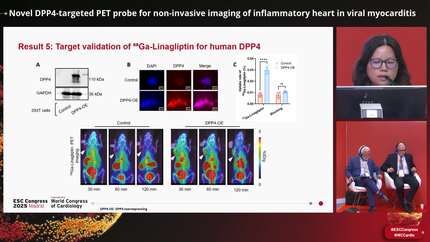
Novel DPP4-targeted PET probe for non-invasive imaging of inflammatory heart in viral myocarditis
European Heart Journal


Abstract
Myocarditis, with viral infection being the most common trigger, is an immune-mediated inflammatory disease. Currently, there are no effective non-invasive imaging diagnostic approaches to specifically target inflammation in myocarditis.
This work aims to construct a small-molecule PET probe targeting dipeptidyl peptidase-4 (DPP4), a surface protein strongly upregulated on activated immune cells, and evaluate its potential application in imaging viral myocarditis.
Viral myocarditis model was established by infecting BALB/c mice with Coxsackievirus B3 (CVB3). Gross observation of the heart and hematoxylin & eosin staining were used to assess inflammatory infiltration and confirm the successful establishment of the model. DPP4 expression in immune cells in myocarditis and control hearts was detected by immunostaining. DPP4-targeting molecular probe 68Ga-Linagliptin was constructed by conjugating 68Ga and DOTA with Linagliptin, a small molecular DPP4 inhibitor in clinic use for Diabetes. The efficacy and specificity of the probe were evaluated via PET/CT imaging in mice with myocarditis and normal mice with axillary injections of HEK293T cells overexpressing DPP4. 18F-fluorodeoxyglucose (FDG) was used as a positive control for inflammation detection. Safety of 68Ga-Linagliptin and therapeutic potential of Linagliptin were also assessed by blood tests, staining, and echocardiography .
DPP4 was highly expressed on immune cells in the heart after CVB3 infection. 68Ga-Linagliptin demonstrated efficient and specific binding to DPP4-overexpressing 293T cells in vivo and in vitro. PET imaging of 68Ga-Linagliptin effectively reflected the inflammation in the heart of mice with myocarditis, with a low background in control hearts. Liver and kidney function remained normal in mice with administration of 68Ga-Linagliptin. In addition, treatment of Linagliptin improved cardiac function in mice with CVB3 infection.
68Ga-Linagliptin is a promising radioactive tracer for imaging of inflammation in myocarditis, which warrants further clinical investigation.


You may be interested in