Impact of the implantation of one MitraClip on the mitral valve anatomy: NTR vs. XTR
European Heart Journal - Acute CardioVascular Care


Abstract
Type of funding sources: None.
Percutaneous mitral repair using MitraClips (MC) for severe symptomatic regurgitation (MR) has emerge as an alternative treatment for selected high risk surgical patients. Despite the high number of cases treated with both iterations of the MC, the small NTR and the big XTR, the impact of the device size on the mitral valve area (MVA), the morphology of the annulus, the severity of the MR and the use of multiple device is still unknown.
High quality volume focused on the MV were acquired during each intervention. Using a dedicated 3-D analysis software the dimensions of the annulus, the MVA and the 3-D vena contracta area (VCA) were evaluated before and after clipping. After implantation, the area of both orifices were measured independently and summed.
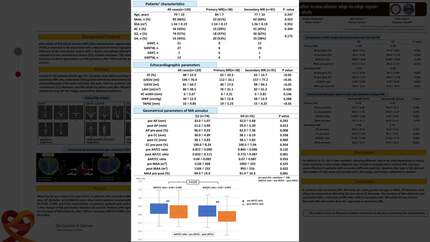
A total of 120 patients were included, 63 received a NTR and 57 a XTR. Before clipping, XTR cases had bigger MVA (5.9+/-1.7 vs. 4.9+/-1.3 cm2, p .001), a trend toward bigger VCA (0.56+/-0.7 vs. 0.51+/-0.9 cm2, p .073) and no difference in the anteroposterior (AP, 3.5 [3.1-4] vs. 3.5 [3.3-3.8] cm, p .47) and the lateromedial (LM, 4.2 [3.8-4.5] vs. 4.3 [4.0-4.5] cm) diameter of the annulus compared to NTR cases. One MC implantation produced a significant decrease of all these parameters but only MVA was significantly more reduce by XTR (Figure 1). The patients receiving a NTR as first MC did not need more often a second clip (31/63 vs. 26/57, p .072).
On average, both devices produce a MVA reduction of more than 50% and an indirect annuloplasty mainly in the anteroposterior direction. The use of an XTR as first MC do not decrease the probability of the necessity of a second one. All these parameters should be carefully taken into account when defining the implantation strategy. Abstract Figure.
Contributors

M Kassar
Author
You may be interested in