Temporal trends of normal scan results and pretest probability in myocardial perfusion imaging in a tertiary referral center in Switzerland between 2000 and 2023
European Heart Journal


Abstract
A high proportion of patients referred for coronary artery disease (CAD) testing with myocardial perfusion imaging (MPI) have normal test results. With decreasing prevalence of CAD and overestimation of pre-test probability (PTP) by existing models, normal tests results have continuously increased over time.
This study aimed to evaluate temporal trends of normal scan results over 23 years in a large referral center in Switzerland.
Data from all available MPI scans (Single Photon Emission Computed Tomography and Positron Emission Tomography) performed between 2000 and 2023 were extracted from the electronic medical record. An abnormal scan result was defined as Summed Stress Score (SSS) ≥4. PTP according to the 2019 ESC guidelines on chronic coronary syndromes was calculated. Temporal trends of Summed Rest Score (SRS), Summed Difference Score (SDS) and SSS were also analyzed.
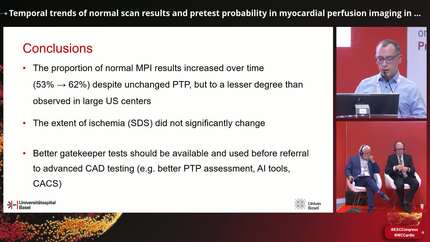
Overall, 45’113 patients were analyzed. The mean age was 66 ± 11 years, 35% were female. Typical and atypical angina were reported in 22% and 24%, respectively. Overall, MPI was abnormal in 44%. Small (SDS ≥2) and relevant (≥10% myocardium involved) ischemia was observed in 36% and 13%, respectively. The proportion of normal scan results increased from 53% in 2000 to 62% in 2023 (p < 0.001) (figure 1). SRS and SSS, but not SDS decreased over time (figure 2). In multivariate regression analysis, the year of exam was a significant predictor for normal MPI (OR 1.026 (95% CI 1.023-1.029), p < 0.001). PTP remained unchanged over time (20% in 2000 vs. 21% in 2023) (figure 1).
The proportion of normal scan results significantly increased over 23 years, whereas PTP remained unchanged. To counter this trend and reduce unnecessary diagnostic tests, patient preselection must further be optimized.