Extracellular volume fraction provides incremental prognostic value in functional tricuspid regurgitation
European Heart Journal


Abstract
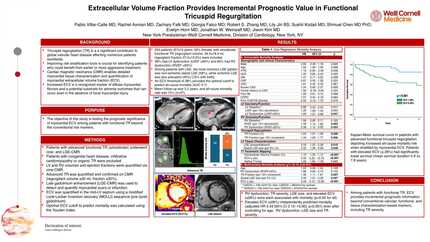
Functional tricuspid regurgitation (TR) is a known predictor of adverse prognosis, yet risk stratification remains largely based on TR severity. Cardiac magnetic resonance (CMR) enables detailed myocardial tissue characterization and quantification of extracellular volume fraction (ECV), an increasingly recognized marker of diffuse myocardial fibrosis and a potential substrate for adverse outcomes that can occur even in the absence of focal myocardial injury.
This study tested prognostic significance of ECV among patients with functional TR.
The population comprised advanced (≥moderate) functional TR patients undergoing CMR. Patients with primary tricuspid pathology or infiltrative cardiomyopathies were excluded. ECV was quantified in the mid-LV septum using a modified Look-Locker inversion recovery (MOLLI) sequence (pre-/post-gadolinium). Focal myocardial injury was identified on late gadolinium enhancement (LGE); ancillary analyses included cine-CMR quantification of chamber volumes and function. Follow-up for all-cause mortality was attained blinded to CMR analysis.
Among 253 patients (67±15 years; 53% female) with ≥moderate functional TR (regurgitant volume 34.5±18.4 ml, regurgitant fraction 37.2±13.0%), 39% had LV dysfunction (LVEF <50%) and 60% had RV dysfunction (RVEF <50%). Among patients with LGE, the most common LGE pattern was non-ischemic septal LGE (58%), while ischemic LGE was less prevalent (45%) [12% with both]. An ECV threshold of 28% provided the optimal cutoff to predict all-cause mortality (AUC 0.7). Notably, 46% of patients without LGE had elevated ECV (≥28%). Over a mean follow-up of 2.2±2.2 years, 37 patients (15%) died. In univariable analysis, RV dysfunction, TR severity, LGE size, and elevated ECV (≥28%) each associated with mortality (p<0.05 for all; Table). In multivariable analysis, elevated ECV (≥28%) independently predicted mortality (adjusted HR 5.43 [95% CI 2.12–13.90]; p<0.001), even after controlling for RV dysfunction (HR 1.98 [95% CI 0.83–4.73]; p=0.122), LGE size (per 5% LV; HR 2.33 [95% CI 1.01–5.39]; p=0.047), and TR severity (HR 1.46 [95% CI 1.11–1.91]; p=0.007). Kaplan-Meier analysis further demonstrated that patients with elevated ECV (> 28%) had significantly lower survival (log-rank p<0.001; mean survival duration 5.9 vs. 7.8 years [Figure]).
Among patients with functional TR, ECV provides incremental prognostic information beyond conventional valvular, functional, and tissue characterization-based markers, including TR severity.
Contributors

P Villar-Calle
Author
R Axman
Author
Z Falk
Author
G Falco
Author
R S Zhang
Author
L Jin
Author
S K Kodali
Author
S Chen
Author
E M Horn
Author
J W Weinsaft
Author
J Kim
Author
You may be interested in