Comparative assessment of CMR-determined extracellular volume metrics in predicting adverse outcomes
European Heart Journal


Abstract
Extracellular volume (ECV) by cardiovascular magnetic resonance (CMR) imaging is associated with disease burden and clinical outcomes. Recent studies in patients with valvular heart disease (VHD) suggested, that indexed total ECV (iECV)=ECVx(LVmass/1.05)/body surface area may supersede ECV for prognostication. We aimed to compare the prognostic capability of conventional ECV and iECV in an all-comer CMR cohort.
From January 2012 to 2023, ECV and iECV were measured in consecutive CMR patients. Adverse outcomes were defined as a composite of hospitalization for heart failure (HF) and/or death. All patients underwent transthoracic echocardiography within 3 weeks of CMR.
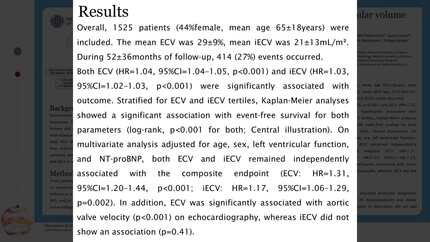
Overall, 1525 patients (44%female, mean age 65±18years) were included. The mean ECV was 29±9%, mean iECV was 21±13mL/m². During 52±36months of follow-up, 414 (27%) events occurred. Both ECV (HR=1.04, 95%CI=1.04–1.05, p<0.001) and iECV (HR=1.03, 95%CI=1.02–1.03, p<0.001) were significantly associated with outcome. Stratified for ECV and iECV tertiles, Kaplan-Meier analyses showed a significant association with event-free survival for both parameters (log-rank, p<0.001 for both; Central illustration). On multivariate analysis adjusted for age, sex, left ventricular function, and NT-proBNP, both ECV and iECV remained independently associated with the composite endpoint (ECV: HR=1.31, 95%CI=1.20–1.44, p<0.001; iECV: HR=1.17, 95%CI=1.06–1.29, p=0.002). In addition, ECV was significantly associated with aortic valve velocity (p<0.001) on echocardiography, whereas iECV did not show an association (p=0.41).
Both conventional ECV and iECV provided profound prognostic information regarding the risk of HF hospitalizations and death. However, iECV, which is more complex to determine, did not add value.
Contributors



You may be interested in