Reduced MRI-based right-to-left ventricular blood pool T2 ratio predicts adverse events and impaired cardiopulmonary function in heart failure patients
European Heart Journal


Abstract
Cardiovascular magnetic resonance (CMR) T2 mapping is a sensitive tool for assessing blood oxygenation levels. A reduced right ventricular (RV) to left ventricular (LV) blood pool (BP) T2 relaxation time has been observed in patients with Heart Failure (HF) - due to increased peripheral oxygen extraction -, but its association with adverse clinical outcomes and physiologic parameters remains unexplored. This study aimed to assess the prognostic value of the RV/LV BP T2 ratio and its correlation with cardiopulmonary exercise metrics in patients with HF with reduced and mildly reduced ejection fraction (HFrEF and HFmrEF).
This retrospective, single-center cohort study included adult patients with HF and LVEF <50% who underwent CMR with T2 mapping (T2-prep SSFP) between 2019-2024. Patients with congenital heart disease and/or known shunts were excluded. RV and LV BP T2 values were measured on a mid-ventricular short-axis slice, excluding trabeculations, papillary muscles, and inflow artifacts. The study endpoint was a composite of all-cause death or hospital admission for decompensated HF. In a subset of patients who underwent clinically indicated cardiopulmonary exercise testing (CPET) within one year of CMR, RV/LV BP T2 ratio was correlated with metrics of HF severity.
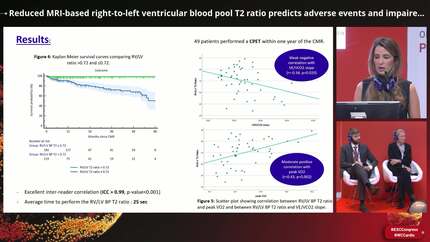
A total of 301 patients were included (66% male, mean age 60±16 years, median LVEF 35%; 36% with ischemic etiology). The mean RV/LV BP T2 ratio was 0.70±0.11. After a median follow-up of 22±17months, 49 patients (14.1%) experienced the outcome (31 deaths, 18 HF hospitalizations). ROC curve analysis showed good discriminatory power of RV/LV BP T2 ratio for predicting outcome, with an AUC of 0.76 (95% CI: 0.69-0.83, p = 0.001). A RV/LV BP T2 ratio cut-point of 0.72 had 94% sensitivity and 46% specificity for MACE. Patients with values ≤ 0.72 represent 61% of the population but account for 94% of the events – Figure 2. After Cox regression adjustment for age, LVEF, NYHA class and ischemic etiology, RV/LV BP T2 ratio remained an independent predictor of outcome (adjusted HR 0.92 per 1% increase, 95%CI 0.89-0.96, p<0.001). In the subset of 49 patients with CPET, RV/LV BP T2 ratio correlated with peak oxygen uptake (VO2, r= 0.43, p=0.002) and ventilatory efficiency (VE/VCO2, r=-0.34, p=0.020).
Decreased RV/LV T2 ratio correlates with impaired CPET parameters and is independently associated with higher risk of death and HF hospitalization. This biomarker can be readily obtained from routine CMR protocols and may serve as an additional tool to aid in assessing HF severity and prognosis.
Contributors

A R Bello
Author
P Lopes
Author
G Cunha
Author
B Rocha
Author
P Freitas
Author
S Guerreiro
Author
C Silva
Author
K Stankowski
Author
F Gama
Author
J Abecassis
Author
A Ferreira
Author
You may be interested in