Early quantitative stress-CMR identifies microvascular dysfunction as a potential mechanism of myocardial injury in patients with working diagnosis MINOCA and otherwise normal CMR scan
European Heart Journal


Abstract
Coronary microvascular dysfunction (CMD) is considered a potential cause of myocardial infarction with nonobstructive coronary arteries (MINOCA).
To evaluate presence of CMD, using quantitative perfusion stress-CMR as part of a diagnostic work-up in consecutive patients with working diagnosis MINOCA and otherwise normal CMR scan.
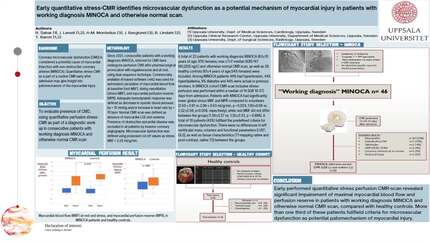
Since 2021, consecutive patients with a working diagnosis of MINOCA, referred for CMR have undergone perfusion CMR after pharmacological provocation with regadenosone and at rest, using dual sequence technique. Myocardial blood flow at baseline (rest MBF), during vasodilation (stress MBF), and myocardial perfusion reserve (MPR) were calculated. Normal CMR scan was defined as an absence of myocardial LGE and oedema.
A total of 23 patients with a working diagnosis MINOCA (63±10y;61% females; max cTnT median (IQR) 147(74;208) ng/L) and otherwise normal CMR scan, as well as 26 healthy controls (61±4y;54% females) were included. Among MINOCA patients 44% had hypertension, 44% hyperlipidemia, 9% diabetes and 44% were actual or previous smokers. In MINOCA cohort, CMR scan inclusive stress-perfusion was performed within a median of 15 (IQR 10-37) days from admission. Patients with MINOCA had significantly lower global stress MBF and MPR compared to volunteers (2.50±0.81 vs 2.96±0.53 ml/g/min, p=0.023; 1.85±0.56 vs. 2.32±0.58, p=0.006, respectively), while rest MBF did not differ between the groups (1.35±0.33 vs. 1.38±0.27, p=0.688), Fig.1. Ten patients (43%) fulfilled criteria for microvascular dysfunction (MBF<2.25 ml/g/min). There were no differences in left ventricular mass, volumes, function or myocardial tissue characteristics (T1- and T2-mapping) between the groups.
Early performed quantitative stress perfusion CMR scan revealed significant impairment of maximal myocardial blood flow during stress and perfusion reserve in patients with a working diagnosis of MINOCA and otherwise normal CMR scans, compared with healthy controls. More than one third of these patients fulfilled the criteria for microvascular dysfunction as a potential pathomechanism of myocardial injury.
Contributors


You may be interested in