The prognostic value of right ventricular kinetic energy for predicting adverse events in hypertrophic cardiomyopathy
European Heart Journal


Abstract
The right ventricle (RV) in hypertrophic cardiomyopathy (HCM) is seldom studied, while the changes in hypertrophied left ventricular wall might affect the RV blood flow kinetics due to the biventricular interaction.
To assess the prognostic value of RV blood flow kinetic energy (KE), derived from four-dimensional (4D) flow cardiac magnetic resonance (CMR) in HCM patients.
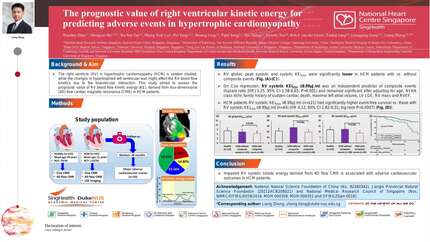
We retrospectively enrolled 165 patients with clinically diagnosed HCM who had undergone prior cine, 4D flow, and late gadolinium enhancement (LGE) CMR; and 115 healthy controls with similar mean age and sex distribution from a CMR registry study. We performed all CMR analyses in a core lab, including RV KE normalized to RV end-diastolic volume (KEiEDV) at various cardiac phases: global, peak systolic, systolic, diastolic, peak E-wave and peak A-wave). Study endpoint was time to first occurrence of the composite of sudden cardiac death, heart failure hospitalization, and stroke or systemic embolism. Cox regression and receiver-operating characteristic analyses were performed.
Compared with controls, HCM patients had significantly lower RV global, diastolic, peak E-wave and KEiEDV E/A ratio, and higher RV peak systolic KEiEDV (Table). After median follow-up of 38 months (IQR: 23 to 48 months), 30 (18.2%) HCM patients experienced outcome events. RV global, peak systolic and systolic KEiEDV were significantly lower in HCM patients with vs. without composite events (Fig. (A)-(C)). RV systolic KEiEDV had the best discrimination (ROC AUC 0.708) HCM patients with events than conventional RV volumetric parameters. On Cox regression, RV systolic KEiEDV ≤8.99µJ/ml was an independent predictor of composite events (hazard ratio [HR] 3.25, 95% CI 1.58-6.65; P=0.001) and remained significant after adjusting for age, NYHA class III/IV, family history of sudden cardiac death, maximal left atrial volume, LV LGE, RV mass and RVEF (HR 2.23, 95% CI 1.07-4.63; P=0.032 to HR 3.15, 95% CI 1.45-6.83; P=0.004). HCM patients RV systolic KEiEDV >8.99µJ/ml (n=121) had significantly higher event-free survival vs. those with RV systolic KEiEDV ≤8.99µJ/ml (n=44) (HR 4.12, 95% CI 1.82-9.31; log-rank P=0.0007) (Fig. (D)).
Impaired RV systolic KE 4D flow CMR is associated with adverse cardiovascular outcomes in HCM patients.



You may be interested in