Prognostic value of mutation genes and LGE patterns in pediatric genetic cardiomyopathy
European Heart Journal


Abstract
The "2023 ESC Guidelines for the Management of Cardiomyopathies" emphasized the significance of Late Gadolinium Enhancement (LGE) and genotype, particularly pathological/likely pathological (P/LP) genotypes, in diagnosing and predicting the prognosis of cardiomyopathy. However, the prognostic implications of LGE and genotype in pediatric cardiomyopathy remain unclear, and there are limitations in determining the pathological types of mutation genes in genetic testing for children.
This study aims to investigate the prognostic roles of mutation genes and LGE patterns in pediatric genetic cardiomyopathy.
This retrospective study included 75 children aged 0-18 years with five common cardiomyopathy phenotypes who underwent genetic testing and enhanced cardiac magnetic resonance imaging from 2016 to 2023. Data on conventional cardiac function parameters, LGE patterns (combinations, lineal midwall, right ventricular(RV) insertion, subendocardial, subepicardial), and cardiomyopathy-related gene mutation types were collected. Mutations were classified according to the American College of Medical Genetics and Genomics (ACMG) guidelines as pathogenic (P), likely pathogenic (LP), variants of uncertain significance (VUS), likely benign (LB), or benign (B). Additionally, mutations were categorized based on gene function or outcome into structural proteins and components, cytoskeleton and connections, ion channels, energy metabolism, signal transduction, and regulatory factors. The presence of desmosomal gene mutations was also noted. Major Adverse Cardiovascular Events (MACE) were defined as sudden cardiovascular death, aborted sudden cardiovascular death, malignant arrhythmia, Implantable Cardioverter Defibrillator shock, and heart failure readmission within five years of follow-up. Cox regression analysis was performed for MACE, utilizing a backward stepwise regression method to select the optimal variable combination for multivariate analysis.
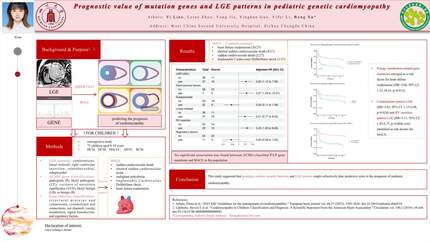
The mean follow-up duration for the 75 children was 27.4 months. The primary MACE event was heart failure readmission (20/27). Notably, no significant association was found between ACMG-classified P/LP gene mutations and MACE. However, energy metabolism-related gene mutations emerged as a risk factor for heart failure readmission (HR=3.66, 95% CI: 1.32-10.16, p=0.013). Combinations pattern LGE (HR=2.83, 95% CI: 1.15-6.98, p=0.024) and RV insertion pattern LGE (HR=3.11, 95% CI: 1.43-6.75, p=0.004) were identified as risk factors for MACE. Upon model inclusion, LVEF ≤ 35%, desmosomal gene mutation, and RV insertion pattern LGE were independent risk factors for MACE, with a C-index of 0.710 and a C-index Standard Error of 0.048 (Figure 1 & 2).
This study suggested that genotype, cardiac systolic function, and LGE patterns might collectively play predictive roles in the prognosis of pediatric cardiomyopathy. | Survival Curves | Forest Pots
Contributors


You may be interested in