Feature tracking-cardiovascular magnetic resonance to predict major adverse cardiovascular events in patients with cardiac amyloidosis
European Heart Journal


Abstract
Cardiac magnetic resonance (CMR) has gaining a pivotal role in the diagnostic workflow of cardiac amyloidosis (CA). The analysis of myocardial torsion mechanisms through Feature-Tracking (FT) for the assessment of left ventricular (LV) strain may represent a more sensible tool for the evaluation of myocardial contractility, with potential diagnostic and prognostic implications. However, data is scarce on the role of FT-CMR in CA. Our study aimed to shed light on its prognostic significance.
We recruited patients 81 prospectively followed in our cardiomyopathy unit, for a mean period of 10 years (from 2010 to 2020) who were diagnosed with CA. Baseline clinical, laboratory and echocardiographic data were obtained. Contrast-enhanced CMR was performed after the exclusion of contraindications on a 1.5 T clinical scanner. Routine analysis was performed with a semi-automatic software for volumetric analysis. All strain parameters were measured off-line using dedicated software. LV global circumferential strain (GCS) and global radial strain (GRS) were derived from 2D b-SSFP cine images in short-axis views. Global longitudinal strain (GLS) was obtained from cine SSFP images of 2-, 3- and 4-chamber long-axis views. The primary endpoint of the study was all-cause mortality. Secondary endpoints were CV mortality and acute heart failure (AHF).
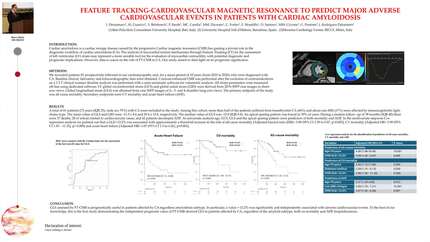
A total of 81 patients [72 years (IQR 25), male sex 79%] with CA were included in the study. Among this cohort, more than half of the patients suffered from transthyretin CA (68%) and about one-fifth (17%) were affected by immunoglobulin light-chains type. The mean value of GLS and GRS were -11.5 ± 4.6 and 29.4 ± 15.8, respectively. The median value of GCS was -15.8 (IQR 8.4). An apical sparing
pattern was found in 39% of cases. During a median follow- up of 38 months (IQR 40) there were 37 deaths, 28 of whom related to cardiovascular cause, and 42 patients developed AHF. At univariate analysis age, GCS, GLS and the apical sparing pattern were predictors of both mortality and AHF. In the multivariate stepwise Cox regression analysis we pointed out that a GLS>-12.2% was associated with approximately a threefold increase in the risk of all-cause mortality [Adjusted hazard ratio (HR)= 3.09 (95% CI 1.39 to 6.87, p=0.005], CV mortality [Adjusted HR= 3.98
(95% CI 1.39 – 11.32), p= 0.009] and acute heart failure [Adjusted HR= 3.07 (95% CI 1.5 to 6.26), p=0.001].
GLS assessed by FT-CMR is prognostically useful in patients affected by CA regardless amyloidosis subtype. In particular, a value >-12.2% was significantly and independently associated with adverse cardiovascular events. Kaplan-Meier curves
Contributors


A I Guaricci
Author
Y Belahnech
Author
P Basile
Author
M C Carella
Author
M Dicorato
Author
C Forleo
Author
F Monitillo
Author
D Santoro
Author
M M Ciccone
Author
G Pontone
Author
J Rodriguez-Palomares
Author
You may be interested in