Evaluation of genotype-phenotype correlation in hypertrophic cardiomyopathy using radiomic analysis of cardiac magnetic resonance
European Heart Journal


Abstract
Hypertrophic cardiomyopathy (HCM) is a recognized inheritance cardiomyopathy, with inconclusive evidences correlating genotype and phenotypic features. There is growing interest in correlating imaging features with specific genotypes, with the aim of a more accurate selection of patients eligible for genetic testing. Radiomics is an emerging research field aiming at improving diagnosis and prognosis using quantitative features extracted from medical images and it could prove useful in identifying features computed from Cardiac Magnetic Resonance (CMR) images associated to specific genotypes.
to investigate if radiomic analysis of CMR can predict genotype positivity in a retrospective HCM cohort.
it is a monocentre retrospective study which enrolled all consecutive patients referred to our centre from 2014 to 2024 with diagnosis of HCM who performed CMR with cine images and genetic testing using next generation sequencing (NGS) technique. Radiomic analysis on cine long axis images included a dataset which was split into a training set (further into a learning and a validation subset) and a final test set (20% of the total dataset, used to actually test the final model obtained through training). Four hundred and seventy-four radiomic features were initially extracted. Three feature selection methods (LASSO, P Value and a combination of both) and five classifiers were tested in order to identify the most accurate model. A head to head comparison with Toronto and Mayo score was performed in the final test set.
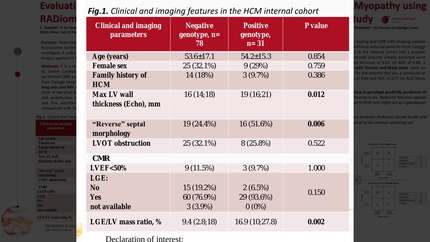
One hundred and nine HCM patients who performed genetic testing and CMR with imaging suitable for radiomic analysis were finally enrolled. Thirty-one patients (28%) had a positive genotype. Mean age of our cohort was 53.8±16.5 years, 34 (31%) were female. Positive genotype patients showed higher maximal wall thickness compared to negative genotype [respectively 19 (16;21) vs 16(14;18)mm, p=0.012]), more frequently a septal reverse morphology [16 (51.6%) vs 19(24.4%) patients, p=0.006], and higher amount of LGE [LGE/Left ventricle (LV) mass ratio 16.9(10.1;27.8)% vs 9.4(2.8;18)% calculated with 5 standard deviation method, p=0.002]. The final radiomic test set included 20 patients, whose 6 (30%) with positive genotype. Twenty-one of the 474 radiomic features initially extracted were selected (mainly shape, first order and texture features). The best-performing model (LASSO + SVM) achieved a balanced accuracy of 87.5%, a sensitivity of 100% and a specificity of 75%, with better performance compared with Toronto and Mayo score.
radiomic analysis of cine pre-contrast CMR imaging showed high sensitivity in negative genotype prediction in HCM, with better performance in a head to head comparison with Mayo and Toronto score. Radiomic features applied to CMR provide a novel, accurate and non-invasive approach to predict genotype in HCM and might act as a gatekeeper for genetic testing. clinical and imaging features HCM radiomic and clinical models comparison



You may be interested in