Right ventricular longitudinal strain but not right ventricular ejection fraction in hypertrophic cardiomyopathy associates with sarcomere positive status and adverse phenotypes
European Heart Journal


Abstract
Right ventricular (RV) dysfunction is a well-established prognostic marker in some cardiac diseases, yet its role in hypertrophic cardiomyopathy (HCM) remains under-investigated. Little is known about the impact of pathogenic or likely pathogenic sarcomeric variants on RV function.
We set out to assess the prevalence of RV dysfunction among HCM patients and its association with sarcomeric variant status and markers of sudden cardiac death risk using data from a large prospective cardiac magnetic resonance (CMR) Registry of HCM - the National Heart, Lung, and Blood Institute (NHLBI) Hypertrophic Cardiomyopathy Registry (HCMR).
A total of 2,303 patients with hypertrophic cardiomyopathy (HCM) (mean age: 50 ± 11 years; 71.1% male) underwent comprehensive CMR imaging. Three-dimensional right ventricular (RV) longitudinal strain was assessed using cine CMR analysed with in-house feature-tracking software. Baseline genetic, demographic, serum biomarker, and clinical data were used for statistical analysis. Impaired strain was inferred from a reference HCM and control population and defined as 2SD from the control mean.
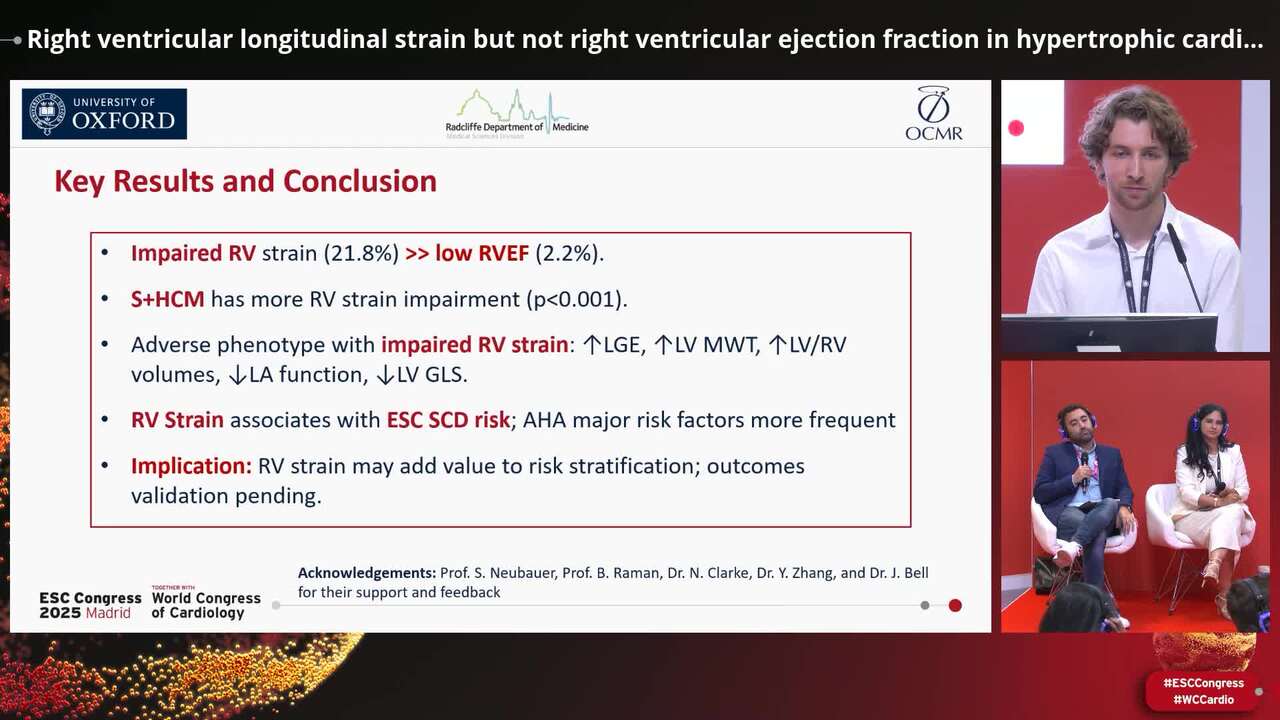
50 (2.2%) patients had impaired RV ejection fraction (RVEF) (< 47% in males, < 49% in females) compared to 501 (21.8%) patients with RV strain impairment (> -6.09%). Impaired RV strain was associated with more adverse phenotypes, higher LV mass index (89 ± 31 g/m2 vs 83 ± 25 g/m2, p = 0.002), increased maximal wall thickness (21.4 ± 5.3 mm vs 20.3 ± 4.6 mm, p < 0.0001), reduced LA contractile function (p < 0.0001), impaired LV global longitudinal strain (p < 0.0001) and higher late gadolinium enhancement (LGE) % (p <0.0001). Impaired RVEF was associated with male sex, lower LA contractile function, yet lower NT-proBNP and decreased maximal wall thickness (19.1 ± 5.9 mm vs 20.6 ± 4.8 mm, p = 0.002). A higher proportion of younger patients with impaired RV strain were sarcomere positive than sarcomere negative (p <0.0001, Fig 1.). Patients with concentric and reverse curvature morphology were more likely to have impaired RV strain (Fig 2.). RV strain, but not RVEF correlated with predicted risks of sudden cardiac death based on ESC HCM risk calculator and AHA risk calculator (p = 0.011). Elastic net regression (Fig 3.) revealed impaired RV strain was associated with larger ventricular volumes, greater extent of LGE, reduced RVEF, LV hypertrophy, impaired LA function, higher baseline Troponin T, and male sex.
Impaired RV strain is prevalent and associated with sarcomere positive status and more adverse HCM phenotypes in low-risk HCM. RV strain has the potential to be prognostically relevant in HCM risk stratification. Association of RV strain with Phenotype



You may be interested in