Left atrial reservoir strain evaluated by cardiac magnetic resonance feature tracking techniques as predictor of clinical events in patients with significant aortic regurgitation: a multicentre study
European Heart Journal


Abstract
Left atrial (LA) deformation techniques have emerged as a promising tool for evaluating the function of cardiac chambers in valvular heart diseases. LA contractile function can be reliably assessed using advanced parameters derived from cardiac magnetic resonance feature tracking (CMR-FT) technology, such as LA reservoir strain (LARS).
The aim of this multicenter study was to evaluate whether LA volume, systolic function, and LASR, as assessed by CMR-FT, could predict adverse clinical outcomes in patients with chronic significant aortic regurgitation (AR) who do not meet surgical criteria.
A total of 335 patients from seven Spanish centers with significant AR (defined as regurgitant fraction >12%) referred for CMR were included. Only asymptomatic patients with preserved left ventricular ejection fraction (LVEF) were eligible for inclusion. Patients with concomitant cardiomyopathies were excluded. Conventional volumetric parameters of the left chambers, as well as LA ejection fraction (LAEF) and LASR, were evaluated. A composite clinical endpoint, including heart failure hospitalization and all-cause mortality, was assessed.
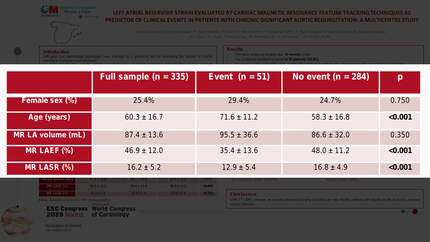
Baseline characteristics were similar between groups (Table). The mean follow-up duration was 37 months (± 86). The composite endpoint occurred in 51 patients (15.2%). LA volume, LVEF, and LARS were significantly impaired in patients who developed events during follow-up (Table). A univariate survival regression analysis revealed that lower LASR by CMR-FT was a significant predictor of worse clinical outcomes (HR 1.13, 95% CI 1.07 – 1.21, p <0.001), with an area under the ROC curve of 0.70. A LARS value of <14% was identified as the optimal cutoff point, with a sensitivity of 63% and specificity of 70%. This threshold predicted clinical events, as shown in the Kaplan-Meier curves (p <0.001). A multivariate analysis confirmed that this association remained independent of age, LVEF, and LV end-systolic diameter.
CMR-FT LARS emerges as a novel advanced imaging tool that can help identify patients with significant AR at risk for adverse clinical outcomes. ROC curve and Kaplan-Meier curve
Contributors



You may be interested in