Left atrial-to-left ventricular indexed volume ratio: a potential prognostic marker for adverse outcomes in patients with heart failure and reduced left ventricular ejection fraction
European Heart Journal


Abstract
Heart failure with reduced left ventricular ejection fraction (HFrEF) represents a heterogenous clinical syndrome, associated with significant morbidity and mortality. Variables such as left ventricular ejection fraction (LVEF), left atrial (LA) and left ventricular (LV) dimensions, alongside estimated pulmonary artery systolic pressure, have been established as indicators of cardiac dysfunction with prognostic relevance. More recently, the ratio between LA indexed volume (LAVi) and LV end-diastolic indexed volume (LVEDVi), referred to as the LA/LV ratio, has emerged as a novel predictor of adverse outcomes.
This study aimed to evaluate the relationship between the LA/LV ratio and other established prognostic markers, as well as to determine its predictive utility in a cohort of patients diagnosed with HFrEF who were acutely hospitalised due to worsening heart failure.
In this single-centre, observational study, retrospective data were collected from patients with a confirmed diagnosis of HFrEF admitted acutely to our institution between 1st January 2015 and 31st December 2023. The diagnosis was established according to the updated European Society of Cardiology guidelines. Demographic data, blood tests, comorbidities, medications and echocardiographic findings were recorded and categorised into quartiles based on the LA/LV ratio. Independent determinants of the LA/LV ratio were identified through linear regression analysis, while its prognostic association with clinical outcomes was assessed using Cox proportional hazards regression. The primary outcome was a composite endpoint of all-cause mortality or rehospitalisation due to heart failure, evaluated at 90 days post-discharge.
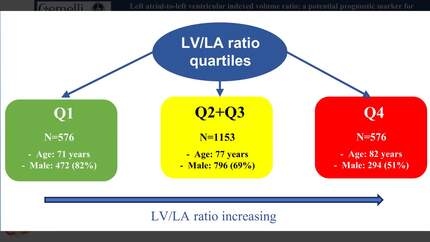
A total of 641 patients (mean age: 82 years; 57% male) were included. Patients in the higher LA/LV ratio quartiles were older, predominantly male and exhibited a higher prevalence of diabetes (p=0.001) and hypertension (p=0.001), alongside elevated N-terminal pro-brain natriuretic peptide concentrations (p=0.001). Compared with LVEF (HR: 1.03; 95% CI: 0.97-1.11), the LA/LV ratio demonstrated a stronger and independent predictive value for the composite endpoint of all-cause mortality or heart failure rehospitalisation (HR: 1.27; 95% CI: 1.11-1.41). Patients in higher LA/LV ratio quartiles exhibited a significantly increased risk of adverse outcomes, as confirmed in both univariate and multivariate analyses.
The LA/LV ratio is frequently elevated in patients with HFrEF and hospitalised due to acute decompensation. This parameter independently predicts adverse outcomes, with higher quartiles identifying patients at increased risk of mortality or rehospitalisation. These findings suggest that the LA/LV ratio may serve as a valuable prognostic marker in this high-risk population.
Contributors

M Busti
Author
L Cacioli
Author
C Cardile
Author
A Forni
Author
L Sanasi
Author
A De Vita
Author
A Piccioni
Author
D Della Polla
Author
G De Matteis
Author
J Lenkowicz
Author
F Franceschi
Author
M Covino
Author
You may be interested in