Right Atrioventricular Coupling Index (RACI) on CMR: a novel predictor of outcomes in pulmonary hypertension
European Heart Journal


Abstract
The right atrioventricular coupling index (RACI), defined as the ratio of right atrial to right ventricular end-diastolic volume, reflects the interplay between right atrial compliance and right ventricular filling pressures. However, the prognostic significance of RACI in pulmonary hypertension (PH) has not been established.
To determine whether RACI predicts clinical outcomes in PH independent of conventional RV risk markers.
The population comprised prospectively enrolled patients undergoing CMR with known or suspected PH. Patients were stratified based on Youden index-derived optimal threshold: RACI<40% [reference] and ≥40% [elevated]. Transthoracic echocardiogram was performed as a secondary measure of right ventricular function and afterload. The primary outcome was a composite of heart failure hospitalization or death.
Among 93 patients (60±13 years, 58% female), 35 (38%) had elevated RACI. Patients with elevated RACI were older (69±11 vs. 55±12 years, p<0.001) and had a higher prevalence of hypertension (77% vs. 40%, p <0.001) [Table]. Elevated RACI was associated with smaller right ventricular chamber volume (RVEDVi: 90 ± 33 vs 107 ± 29 ml/m2, p=0.01), greater RV systolic performance (RVEF: 53% ± 10 vs 47% ± 13, p=0.02) and more significant RA enlargement (55 ± 27 vs 28 ± 10 ml/m2, p<0.001). Despite these differences in chamber geometry and function, there were no significant differences in tricuspid regurgitant volume (22±23 vs 16±15 ml, p=0.20) or pulmonary artery systolic pressure (PASP: 61±20 vs 55±21 mmHg, p=0.25). During a median follow-up of 1.7±1.1 years, 41 patients experienced the primary composite outcome of heart failure hospitalization or death, with substantially higher event rates among those with elevated RACI (60% vs 34%, log-rank p=0.003) [Figure]. In univariable analysis, elevated RACI was associated with over a two-fold increased risk of the primary outcome (HR 2.51 [95%CI 1.33-4.77]; p<0.001). In multivariable analysis, elevated RACI remained a strong independent predictor of adverse outcomes (HR: 3.57 [95%CI 1.64-7.7]; p=0.001), even after controlling for RV chamber size and function.
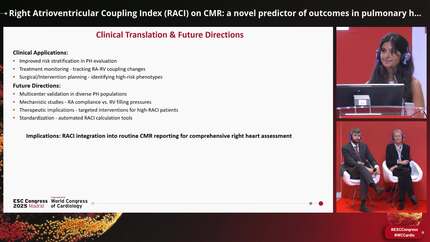
Elevated RACI independently predicts mortality and heart failure hospitalization in PH. Its association with distinct right heart remodeling pattern characterized by preserved RV function, smaller RV size and disproportionate RA enlargement suggests a potential role in refining risk stratification beyond conventional RV parameters.
Contributors

G Falco
Author
New York-Presbyterian Hospital-Weill Cornell Medical Center New York , United States of America
R S Zhang
Author
P Villar-Calle
Author
U Krishnan
Author
J Li
Author
L Jin
Author
A Tsay
Author
E Horn
Author
R Axman
Author
L Rong
Author
P Spincemaille
Author
J Weinsaft
Author
J Kim
Author
You may be interested in