Multicenter cardiovascular magnetic resonance reference ranges and severity grading for ventricular and atrial measurements: insights from the healthy hearts consortium
European Heart Journal


Abstract
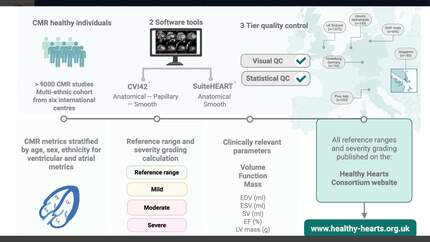
Cardiovascular magnetic resonance (CMR) imaging enables precise, non-invasive assessment of cardiac structure and function, yet the clinical utility of CMR metrics is limited by the lack of comprehensive, population-specific reference values. By directly reanalyzing data from a large, multi-ethnic cohort rather than relying solely on pooled literature, could enable the establishment of standardized reference ranges and severity grading thresholds.
To provide comprehensive, age-, sex-, and ethnicity-stratified CMR reference ranges and severity grading thresholds for key ventricular and atrial parameters.
We analyzed over 9,000 CMR scans from the Healthy Hearts Consortium (HHC), comprising six international cohorts. All individuals were free from overt cardiovascular disease and major comorbidities, ensuring a verified healthy sample. Two automated segmentation software solutions—cvi42 (Circle Cardiovascular Imaging) and suiteHEART (Neosoft)—were used to quantify left and right ventricular volumes, myocardial mass, and atrial volumes in standard cine stacks. All endorsed segmentation modes were applied. Quality control protocol combined expert visual review and statistical outlier analysis. We derived 95% prediction intervals (PI) to define the normal range, with additional severity thresholds for mild (95–99.73% PI), moderate (99.73–99.99% PI), and severe (>99.99% PI) deviation from the reference range.
The final dataset comprised of 9,059 verified healthy adults aged 18–83 years (mean 61 ± 13 years), with a near-equal sex distribution (51% women). Demographics included White (81.6%), South Asian (5.6%), Mixed/Other (5.3%), Black (3.8%), and Chinese (3.7%) participants. Results demonstrated that sex, age, and ethnicity strongly influenced cardiac indices. Men had higher indexed LV and RV volumes and greater myocardial mass than women. Black participants presented the highest indexed LV myocardial mass across age groups, whereas Chinese participants had comparatively lower myocardial mass values (Figure 1). In contrast, atrial volumes remained relatively stable across age categories. Comparative analysis showed minor differences between the two software tools, particularly for atrial parameters; however, derived ejection fractions remained consistent. We established age-, sex-, and ethnicity-stratified reference ranges for key CMR parameters. To facilitate clinical interpretation, we defined severity thresholds corresponding to mild, moderate, and severe abnormalities.
This large-scale, international effort addresses prior limitations in CMR interpretation by offering robust, contemporary reference ranges and severity grading applicable to diverse populations and imaging protocols. Our severity grading thresholds support consistency in clinical reporting and decision-making, enabling clearer identification of early subclinical changes and more accurate monitoring of disease progression. Subset of CMR value ranges in females
Contributors


C Mccracken
Author
D G Condurache
Author
R Bulow
Author
G D Aquaro
Author
F Andre
Author
D Sucha
Author
N C Harvey
Author
T Leiner
Author
C W L Chin
Author
M G Friedrich
Author
A Barison
Author
M Dorr
Author
Z Raisi-Estabragh
Author
S E Petersen
Author
You may be interested in