Risk factors and outcomes associated with right ventricular mass: exploring causality using Mendelian randomisation and cardiac MRI in UK Biobank
European Heart Journal


Abstract
Right ventricular (RV) mass is an important predictor of outcome in patients with pulmonary arterial hypertension (PAH), and there is evidence that extremes of RV mass are associated with worse outcomes at a population level. Beyond PAH, the determinants of RV mass are poorly understood, and the relationships between RV mass and outcomes have not been explored.
UK Biobank is a large prospective cohort study. Demographics, lifestyle and medical history, and blood samples were obtained at enrolment. Health outcomes were ascertained by database linkage. Genotyping was performed using customised Affymetrix arrays. A subset of the cohort underwent cardiovascular magnetic resonance imaging. We used deep learning to derive left ventricular (LV) and RV volumes and mass, and segmentation accuracy was reviewed visually.
We used linear and Cox proportional hazards regression to examine the relationships between cardiovascular risk factors and RV mass, and between RV mass and incident heart failure. We used two sample Mendelian randomisation (MR) to explore the causal associations between genetically determined exposures and outcomes.
Baseline characteristics of the cohort are shown in Table 1.
In a multivariable linear model (Table 2) age, non-white ethnicity and diabetes were associated with lower RV mass. Male sex, height, weight, physical activity and regular alcohol consumption were associated with higher RV mass.
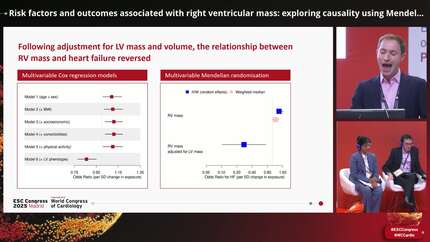
In a multivariable Cox model adjusted for age, sex, body mass index, socioeconomic deprivation, level of education, history of hypertension, diabetes and chronic lung disease, smoking status, alcohol consumption and physical activity, RV mass was associated with a higher hazard of heart failure (HR 1.10, 95%CI 1.01 to 1.19, p = 0.033) (Figure 1). Following additional adjustment for LV mass and LV end-diastolic volume, the direction of the relationship between RV mass and heart failure reversed (HR 0.86, 95%CI 0.78 to 0.95, p = 0.003).
Genetically determined physical activity and alcohol consumption were associated with higher RV mass, although the statistical significance of the latter relationship was not robust across sensitivity analyses (Figure 2a).
In separate MR models, genetically determined LV and RV mass were both associated with higher odds of developing heart failure. In a multivariable MR model controlling for the effect of LV mass, the direction of the relationship between genetically determined RV mass and heart failure reversed, and higher RV mass was associated with lower odds of heart failure (beta -1.058, 95% CI -1.76 to -0.35, p = 0.003), aligning with the observational findings (Figure 2b).
Physical activity is causally associated with higher RV mass. Alcohol consumption is correlated with higher RV mass, although the evidence for causation is less strong. After accounting for LV mass, higher RV mass appears to be protective against heart failure.
Contributors


H Nichols
Author

S Alabed
Author
University of Sheffield Sheffield , United Kingdom of Great Britain & Northern Ireland
A L Valldeperas
Author

G Schiattarella
Author

D Kiely
Author

A Hokmabadi
Author
M Sharkey
Author
R Van Der Geest
Author

A Swift
Author
University of Sheffield Sheffield , United Kingdom of Great Britain & Northern Ireland

N Aung
Author
Queen Mary University of London London , United Kingdom of Great Britain & Northern Ireland
You may be interested in