Left atrioventricular coupling index in health and disease: a longitudinal multicohort analysis
European Heart Journal


Abstract
The Left Atrioventricular Coupling Index (LACI), calculated as the ratio of left atrial (LA) to left ventricular (LV) end-diastolic volume (EDV), reflects coupling between the two chambers and has emerged as a promising novel imaging biomarker. However, its incremental predictive value beyond established clinical and imaging markers remains uncertain, and the absence of established normal reference thresholds precludes broader clinical implementation.
This study leveraged data from the Healthy Hearts Consortium (HHC) and UK Biobank to 1) investigate demographic variations of the LACI in health, 2) generate population-specific reference thresholds, 3) characterise the relationship between LACI and cardiac structure and function in health, and 4) assess the incremental predictive value of the LACI for cardiovascular disease and mortality.
Cardiovascular magnetic resonance (CMR) scans were performed and analysed using standardised protocols. The HHC is an international collaboration encompassing the world’s largest CMR image bank of verified healthy individuals. Age-, sex-, and ethnicity-related variations of the LACI were examined using HHC participants, and population-specific reference thresholds were calculated using the 95% prediction interval method. The UK Biobank was then used to examine associations between LACI and incident atrial fibrillation (AF), heart failure (HF), myocardial infarction (MI), cardiovascular death and all-cause death over a median 5.5-year follow-up period. Cox regression models were adjusted for demographic, clinical and CMR variables (LV ejection fraction, LV mass, LV global longitudinal strain, and LA ejection fraction for AF only).
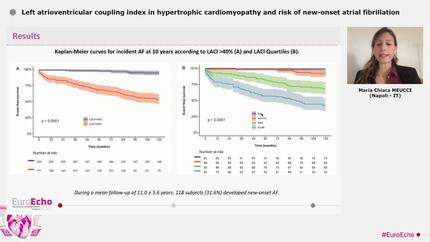
In the HHC cohort (n=7,111, 54% female, median age 61.5 years, 80% White ethnicity), a higher LACI was observed in older individuals, ethnicities other than White, and women, with women showing a greater age-related increase (Fig 1A). After adjusting for age, sex and ethnicity, a higher LACI was associated with poorer LA function (measured by LA ejection fraction, LA global longitudinal strain and LA long-axis strain) and higher LV filling pressures, although only weak associations were found with LV function (Fig 1B). In the UK Biobank (n=25,849, 52% female, median age 63.0 years), a higher LACI (per 1-SD increase) was associated with a greater risk of incident AF [HR 1.25 (1.13-1.37), p<0.001] and HF [HR 1.16 (1.08-1.25), p<0.001], in fully adjusted models (Fig 2A). Applying the newly derived reference thresholds to the UK Biobank cohort revealed that patients with a raised LACI (6.6% of cohort) had higher cumulative incidence rates of AF and HF than those with a normal LACI (93.4% of cohort, Fig 2B).
The LACI is a robust predictor of incident AF and HF with incremental value over established clinical and imaging markers. The newly established population-specific reference thresholds allow for a broad clinical application.
Contributors

R Roy
Author
St Bartholomews and Queen Mary University London , United Kingdom of Great Britain & Northern Ireland

J Salatzki
Author
L Szabo
Author
D G Condurache
Author
J Cooper
Author

A M Salih
Author
University of Leicester Leicester , United Kingdom of Great Britain & Northern Ireland

S E Petersen
Author
Queen Mary University of London London , United Kingdom of Great Britain & Northern Ireland

Z Raisi-Estabragh
Author
Queen Mary University of London London , United Kingdom of Great Britain & Northern Ireland
You may be interested in