Peri-device leak post WATCHMAN implantation in the real world: lessons from computed tomography imaging at follow-up from a prospective multicenter high-volume operator registry in the US
European Heart Journal


Abstract
The FDA approved the WATCHMAN device in March 2015 with the caveat follow-up transesophageal echo (TEE) at 45 days and 1 year post implant to assess peri-device leak (PDL) and device-related thrombus formation (DRT) as an important step before interruption of anticoagulation. However, our understanding of these PDLs is mostly derived from TEE. Gated contrast CT recently emerged as a non-invasive alternative to TEE to follow-up post WATHMAN implanted patients. Current experience with CT is limited to small series and case reports.
Patients were eligible for enrollment in this prospective registry if they were scheduled to undergo implantation with a WATCHMAN FLX or WATCHMAN FLX Pro device. Enrolled patients were implanted with a WATCHMAN device and followed per local standard of care without interference from the central core lab or study leadership. There were no pre-specified endpoints, but analyses include procedural success, procedural complications, leak and thrombus rates as adjudicated by a central imaging core lab. Incomplete seal of the LAA by CT comprises both PDLs, uncovered lobes, as well as micro-flow through the device fabric.
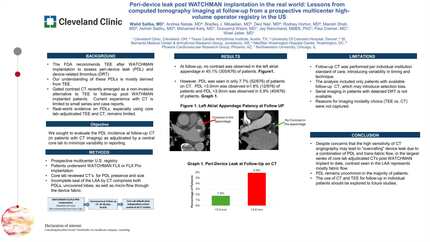
At follow-up, no contrast was observed in the left atrial appendage in 45.1% (305/676) of patients (Figure 1). However, PDL was seen in only 7.7% (52/676) of patients on CT. PDL <3.0mm was observed in1.8% (12/676) of patients and PDL >3.0mm was observed in 5.9% (40/676) of patients (Graph 1).
Despite concerns that the high sensitivity of CT angiography may lead to "overcalling" device leak due to a combination of PDL and trans-fabric flow, in the largest series of core lab adjudicated CTs post WATCHMAN implant to date, contrast seen in the LAA represents mostly fabric flow and PDL remains uncommon in the majority of patients. The use of CT and TEE for follow-up in individual patients should be explored to future studies.

You may be interested in