Extracellular volume as a predictor of heart failure events after transcatheter aortic valve implantation in patients with preserved left ventricular ejection fraction
European Heart Journal


Abstract
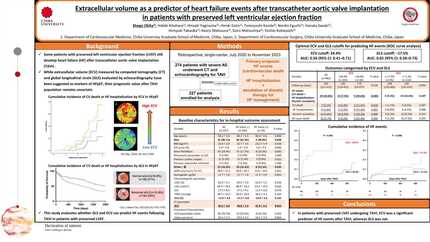
Transcatheter aortic valve implantation (TAVI) has significantly improved outcomes in patients with severe aortic stenosis (AS). However, some patients with preserved left ventricular ejection fraction (LVEF) still develop heart failure (HF) after TAVI. While global longitudinal strain (GLS) evaluated by echocardiography and extracellular volume (ECV) measured by computed tomography (CT) have been suggested as markers of subclinical myocardial dysfunction, their prognostic value in this population remains uncertain.
This study evaluates whether GLS and ECV can predict HF events following TAVI in patients with preserved LVEF.
This retrospective, single-center registry study included 227 patients with severe AS and preserved LVEF (≥50%) who underwent TAVI. Preprocedural echocardiography, including GLS assessment, and computed tomography for ECV measurement were performed. The primary endpoint was post-discharge HF events, defined as a composite of cardiovascular death, HF hospitalization, or escalation of diuretic therapy for HF management. Baseline demographics, clinical variables, and imaging findings were recorded. Receiver operating characteristic (ROC) curve analysis determined the optimal GLS and ECV cutoff values for predicting HF events, and Kaplan-Meier analysis assessed the incidence of HF events stratified by these thresholds.
Over a median follow-up of 236 days, 24 patients experienced HF events. Conventional echocardiographic parameters, including LVEF and diastolic indices, did not significantly differ between patients with and without HF events. Furthermore, GLS was not significantly different between the 2 groups (-15.8% vs. -17.2%, p=0.125). In contrast, ECV was significantly higher in patients with HF events compared to those without (31.9% vs. 30.0%, p=0.022). In Kaplan-Meier analyses, the cumulative incidence of HF events was compared between 2 groups stratified based on the ROC curve analysis-identified thresholds of 34.4% for ECV and -17.5% for GLS. The incidence of HF events was significantly higher in patients ECV >34.4% (log-rank p<0.001, Figure), whereas it tended to be higher in patients with GLS >-17.5% (log-rank p=0.098, Figure). Multivariable Cox regression analysis confirmed that ECV >34.4% was independently associated with increased risk of HF events (p<0.001).
In patients with preserved LVEF undergoing TAVI for severe AS, ECV was a significant predictor of HF events after TAVI, whereas GLS was not. These findings highlight the potential role of ECV in refining risk stratification beyond echocardiographic assessments. Prospective studies are warranted to validate ECV-based risk models and explore targeted interventions for high-risk patients identified by elevated ECV.
Contributors

K Matsuura
Author
G Matsumiya
Author
Y Kobayashi
Author
H Kitahara
Author
H Yaginuma
Author
H Goto
Author
H Yamamoto
Author
T Kanda
Author
N Eguchi
Author
H Sasaki
Author
H Takaoka
Author
You may be interested in