Epicardial fat: a non-invasive, non-contrast imaging biomarker for high-risk plaque monitoring
European Heart Journal


Abstract
Coronary computed tomography angiography (CCTA) is a viable method for monitoring high-risk plaque, however, non-contrast calcium scoring (CAS) has a limited utility in this context. The search for novel non-contrast imaging biomarkers able to track vulnerable plaque is necessary.
To investigate correlations between low attenuation plaque (LAP) identified through CCTA and non-contrast CAS, pericardial adipose tissue (PEAT), and epicardial adipose tissue (EAT) in patients with non-obstructive coronary atherosclerosis undergoing serial CCTA.
We analyzed data from 89 participants (40% women, 60±7.7 years) of the Dietary Intervention to Stop Coronary Atherosclerosis in the Computed Tomography (DISCO-CT) study. This single-center, randomized study enrolled patients with non-obstructive coronary atherosclerosis (stenosis <70%) confirmed in CCTA to assess the effect of intensive diet and lifestyle intervention atop optimal medical therapy versus optimal medical therapy alone (1:1) on coronary plaque regression. CCTA was performed at baseline and repeated at mean follow-up of 66.8±13.7 weeks (2x192 row scanner, temporal resolution 66 ms). CAS and coronary fat were measured in non-contrast sequences using a dedicated software and analysed in relation to contrast-derived LAP, defined as the volume of coronary plaque <30 HU divided by the volume of the vessel and expressed in %.
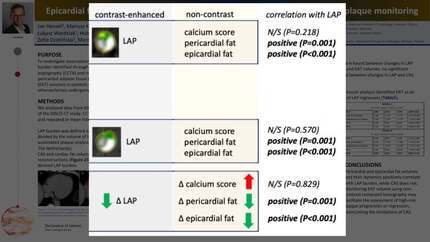
Mean LAP burden decreased by 0.23±1.0% (p=0.041), mean PEAT volume decreased by 17.8±44.1 cm³ (p<0.001), and mean EAT volume decreased by 5.4±19.3 cm³ (p=0.01), while median CAS increased by 21.2 (IQR, 1.7; 71.7) Agatston units (p<0.001), Figure 1.
Positive correlations were found between changes (∆) in LAP burden and changes in both PEAT and EAT volumes (r=0.349, p=0.001, Figure 2A, and r=0.490, p<0.001, Figure 2B, respectively), but not with change in CAS (Figure 2C). Multivariate linear regression analysis identified EAT as an independent predictor of LAP regression (95% CI, 0.007; 0.032; p=0.003).
Pericardial and epicardial fat volumes and their dynamics positively correlate with LAP burden, while CAS does not. Monitoring EAT volume using non-contrast computed tomography may facilitate the assessment of high-risk plaque progression or regression, overcoming the limitations of CAS.
Contributors


M Kruk
Author
C Kepka
Author
M Makarewicz-Wujec
Author
H Krysztofiak
Author
P N Rudzinski
Author
R Dabrowski
Author
Z Dzielinska
Author
You may be interested in