CCTA outperforms CAC Scoring for cardiovascular risk prediction in young patients
European Heart Journal


Abstract
Coronary artery calcium (CAC) scoring and coronary computed tomography angiography (CCTA) are widely used for risk stratification in patients with suspected coronary artery disease. However, younger patients tend to have a higher prevalence of non-calcified coronary plaque, which is not detected by CAC scoring, raising doubts about its prognostic yield in this population.
This study aims to compare the prognostic value of CAC scoring with CCTA-derived plaque quantification across different age groups.
This study included 2,404 patients with suspected CAD and no prior history of the disease. Participants were divided into two age groups: ≤ 60 years (n = 1,021) and > 60 years (n = 1,383). All patients underwent both CAC scoring and CCTA, with coronary plaque burden quantified using an AI-based tool. Two key metrics were assessed: plaque atheroma volume (PAV)—representing total plaque volume normalized to vessel volume—and non-calcified plaque volume percentage (NCPV%). The outcome was a composite of all-cause mortality and non-fatal myocardial infarction. Cox proportional hazards regression models, incorporating CAC score, PAV, or NCPV%, adjusted for clinical risk factors and early revascularization, were used to evaluate prognostic performance.
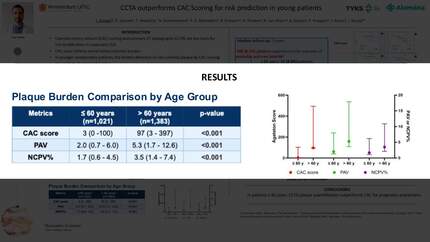
Over a median follow-up of 7.0 years, 208 patients (8.7%) experienced the primary outcome, including 50 (4.9%) in the ≤ 60 years group and 158 (11.4%) in the > 60 years group. Plaque burden and CAC scores were higher in the > 60 years group (Figure 1). Models incorporating CAC, PAV, or NCPV% demonstrated numerically higher ROC AUC values for predicting outcomes in the ≤ 60 years group compared to the > 60 years group (Figure 2). Notably, in the ≤ 60 years group, the PAV model showed significantly better prognostic accuracy than the CAC score model (ROC AUC: 0.772 vs. 0.739, p = 0.013) (Figure 2). However, NCPV% models did not demonstrate superior predictive performance compared to CAC scoring in either group.
In younger patients (≤ 60 years), AI-driven CCTA-derived coronary plaque quantification provides superior prognostic accuracy for adverse cardiovascular events compared to traditional CAC scoring.
Contributors


R Jukema
Author
T Maaniitty
Author
N Nurmohamed
Author
P G Raijmakers
Author
R Hoek
Author
R Driessen
Author
N Planken
Author
N Van Royen
Author
N Nijveldt
Author
A Saraste
Author
P Knaapen
Author
J Knuuti
Author
I Danad
Author
You may be interested in