Development and validation of a long-term clinical prediction model for MACE associated with non-culprit lesions after percutaneous coronary intervention in patients with AMI
European Heart Journal


Abstract
The outcome of patients with acute myocardial infarction (AMI) after percutaneous coronary intervention (PCI) remains a major clinical challenge, particularly the untreated non-culprit lesions (NCLs), which can still lead to major adverse cardiovascular events (MACE). The aim of this study was to investigate the risk factors associated with NCL-MACE in patients with AMI after PCI based on plaque characteristics and clinical information, develop a nomogram prediction model and evaluate its effectiveness.
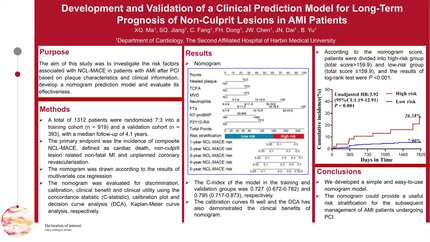
Retrospective selection of AMI patients who underwent successful PCI treatment in our hospital from January 2017 to December 2021, and collection of plaque imaging characteristics and clinical information of patients. A total of 1312 patients were randomized 7:3 into a training cohort (n = 919) and a validation cohort (n = 393), with a median follow-up of 4.1 years. The primary endpoint was the incidence of composite NCL-MACE, defined as cardiac death, non-culprit lesion related non-fatal MI and unplanned coronary revascularisation. The predictive factors included in the nomogram were determined by a multivariate Cox proportional hazards regression model based on the training cohort. The nomogram was evaluated for discrimination, calibration, clinical benefit and clinical utility using the concordance statistic (C-statistic), calibration plot and decision curve analysis (DCA), Kaplan-Meier curve analysis, respectively.
Independent prognostic factors were identified, including healed plaques (HP), thin-cap fibroatheroma (TCFA), multivessel disease (MVD), neutrophils, FT4, NT-proBNP and previous P2Y12 receptor antagonist (P2Y12-RA) use. The C-index of the model in the training and validation groups was 0.727 (0.672-0.782) and 0.795 (0.717-0.873), respectively, and the calibration curve fit well. The DCA has also demonstrated the clinical benefits of nomogram. Furthermore, patients could be divided into two high-risk (total score > 159.9) and low-risk (total score ≤ 159.9) groups according to the model, with log-rank test results P <0.001.
We developed a simple and easy-to-use nomogram model combining plaque characteristics and clinical factors to predict the long-term risk of NCL-MACE in patients with AMI after PCI. The nomogram may provide a useful risk stratification for the subsequent management of AMI patients undergoing PCI. The Study Flow Diagram


You may be interested in