Optimizing stenosis quantification by a novel interpolation-based approach: diagnostic performance data from CREDENCE AND PACIFIC-1
European Heart Journal


Abstract
Traditional assessment of maximum percent diameter stenosis using coronary computed tomography angiography (CCTA) relies on a proximal reference vessel diameter as denominator. However, in long lesions with significant coronary artery tapering, this approach may lead to inaccuracies.
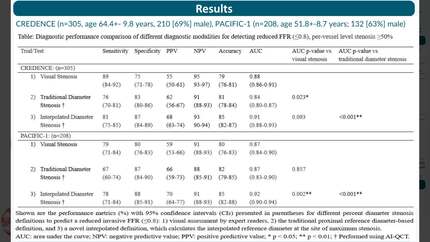
This study evaluated the diagnostic performance of a novel stenosis definition that uses an interpolated vessel diameter at the site of maximum obstruction as denominator (Figure).
A post-hoc analysis of the CREDENCE and PACIFIC-1 studies was performed. In both studies, patients with suspected coronary artery disease (CAD) had prospectively undergone CCTA and invasive coronary angiography (ICA) with invasive fractional flow reserve (FFR) measurements. CCTA scans were analyzed using atherosclerosis imaging-quantitative CT (AI-QCT). Diagnostic performance of three stenosis definitions was compared against an invasive FFR (<0.8) reference standard: (1) visual assessment by expert readers, (2) the traditional definition reference diameter-based definition by AI-QCT, and (3) a novel interpolated definition, calculating the interpolated reference diameter at the maximum stenosis site.
On a per-vessel level, in CREDENCE (n=305, age 64.4+- 9.8 years, 210 [69%] male), AUCs for visual assessment, traditional definition by AI-QCT, and interpolated definition were 0.88 (CI 0.86–0.91), 0.84 (CI 0.80-0.87, p=0.023), and 0.91 (CI 0.88-0.93, p=0.093; Table), respectively. In PACIFIC-1 (n=208, age 51.8+-8.7 years; 132 [63%] male), AUCs were 0.87 (CI 0.84-0.90), 0.87 (CI 0.83-0.90, p=0.857), and 0.92 (CI 0.90-0.94, p=0.002; Table).
A novel AI-QCT-based interpolated stenosis definition demonstrated enhanced diagnostic performance compared to both the traditional definition and visual assessment for predicting reduced FFR. Through the incorporation of true vessel morphology at the site of maximum stenosis, this novel definition may enhance diagnostic accuracy of non-invasive CAD evaluation through CCTA and thereby reduce unnecessary ICA referrals.
Contributors


N S Nurmohamed
Author
I Danad
Author
R Jukema
Author
R Sprengers
Author
A D Choi
Author
A R Van Rosendael
Author
P Knaapen
Author
You may be interested in