The association between coronary computed tomography angiography- derived coronary artery volume to myocardial mass ratio and plaque volume in patients with severe coronary artery disease
European Heart Journal


Abstract
Artificial Intelligence-based Quantitative Coronary Plaque and Hemodynamic Analysis (AI-QCPHA) of computed tomography angiography (CCTA) enables non-invasive assessment of the coronary artery lumen volume to myocardial mass (V/M) ratio, percent left ventricular myocardial blood flow (LV%MYO) at risk, and quantitative plaque volume and composition analysis. We investigated the relationships between global and regional V/M ratios and plaque quantification in patients with severe coronary artery disease.
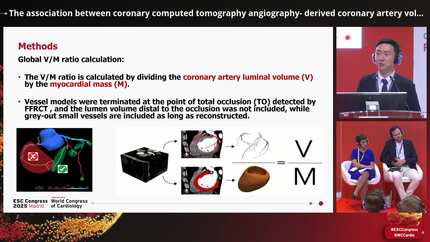
This is a sub-analysis of the first-in-human FASTTRACK CABG trial. AI-QCPHA analysis (HeartFlow, Mountainview, CA, USA) was used to assess V/M ratios, LV%MYO, and total (TPV), calcified (CP), non-calcified (NCP), and low-attenuation plaque (LAP) volumes. The global V/M ratio was calculated from the segmented coronary luminal volume (V) and left ventricular myocardium mass (M), while the regional V/M ratios were derived from the regional V and the regional M based on the LV%MYO (Figure 1).
AI-QCPHA analysis was feasible in 106 of the 114 patients. Comparing with the high V/M group, patients with low V/M ratios had higher LV%MYO at risk (79.1% vs. 65.8%, p<0.001) but lower TPV (986 mm³ vs. 1197 mm³, p=0.046), driven by lower NCP (657 mm³ vs. 925 mm³, p=0.005) though their percent atheroma volume (PAV) remained higher (47.2% vs. 40.4%, p=0.012) and their vessel volume was lower, suggesting constrictive remodelling. Due to its low partition in LV%MYO, the RCA had the highest V/M ratio, while the LAD exhibited the highest TPV, NCP, CP, LAP, and PAV. Except for the RCA, the global, LAD, and LCX V/M ratios were associated with TPV and NCP. PAV was an independent predictor for low global V/M ratio (Figure 2).
In patients with severe CAD, a low V/M ratio was associated with a higher LV%MYO at risk and lower absolute plaque volume but not with relative plaque burden, suggesting an advanced vessel remodelling process. Regional variations in the V/M ratio and its association with plaque composition were noticeable, suggesting distinct differences in vessel-specific CAD characteristics.
Contributors


P Revaiah
Author
D Keulards
Author
A Updegrove
Author
C Taylor
Author
J Narula
Author
J D Puskas
Author
K Tanaka
Author
J De Mey
Author
T Doenst
Author
S Mushtaq
Author
G Pontone
Author
D Andreini
Author


You may be interested in