Impact of acute coronary revascularization on coronary computed tomographic angiography-derived extracellular volume fraction and coronary flow capacity by transthoracic echocardiography
European Heart Journal


Abstract
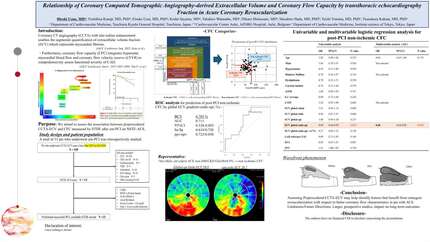
Coronary computed tomographic angiography (CCTA) with late-iodine enhancement enables the segmental quantification of extracellular volume fraction (ECV) which represents myocardial fibrosis. Coronary flow capacity (CFC) integrates hyperemic myocardial blood flow and coronary flow velocity reserve (CFVR) to comprehensively assess functional severity of coronary artery disease. However, the relationship between coronary CT findings and CFC remains unclear.
We aimed to assess the association between preprocedural CCTA-derived ECV and CFC measured using stress-transthoracic Doppler echocardiography (STDE) post-emergent PCI in patients with non-ST elevation acute coronary syndrome (NSTE-ACS).
A total of 33 NSTE-ACS patients who underwent STDE examinations of left anterior descending arteries after emergent PCI was retrospectively studied. Preprocedural CCTA-derived ECV and post-PCI STDE parameters including CFC were investigated. Hyperemic diastolic peak velocity (hDPV) was used as a surrogate of volumetric coronary flow. Using the reported thresholds for ischemia and normal perfusion, vessels were stratified in two CFC categories: ischemic and non-ischemic CFC. Factors to predict post-PCI non-ischemic CFC were evaluated.
In a total cohort, global whole ECV value is 34.5 % (median, IQR 33.0-39.2 %), endocardial ECV is 38.0 % (median, IQR 33.8-42.7 %), epicardial ECV is 31.8 % (median, IQR 30.6-36.5 %). Five cases (16.2 %) showed lower endocardial ECV than that of epicardial ECV. Pre-PCI epicardial fat attenuation (EFA), post-PCI hDPV, and post-PCI CFVR were significantly higher in patients with low versus high endocardial (low epicardial) ECV. On multivariable analysis, pre-PCI higher epicardium ECV and EFA (adjusted odds ratio: 1.32 and 0.58, respectively) were independently predictive of normal CFC.
Preprocedural CCTA-derived ECV may help identify lesions that subsequently develop normal CFC coronary flow characteristics after emergent revascularization in patients with ACS.
Contributors

Y Kanaji
Author
E Usui
Author
T Nagamine
Author
K Sayama
Author
H Shimosato
Author
T Watanabe
Author
T Mineo
Author
K Nogami
Author
M Hada
Author
M Hoshino
Author
T Sugiyama
Author
T Yonetsu
Author
T Kakuta
Author
You may be interested in