Expanding the role of coronary computed tomography angiography in preoperative coronary evaluation for valve surgery: results and safety outcomes
European Heart Journal


Abstract
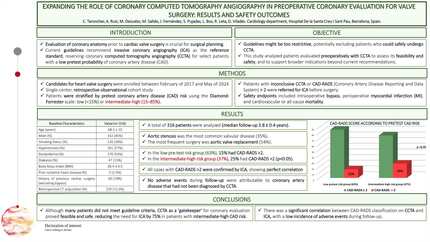
Evaluation of coronary anatomy prior to cardiac valve surgery is crucial for surgical planning and preventing complications. Current guidelines recommend invasive coronary angiography (ICA) as the reference standard, reserving coronary computed tomography angiography (CCTA) for select patients with low pretest probability of coronary artery disease (CAD).
Guidelines may be overly restrictive, excluding patients who could safely undergo CCTA without compromising outcomes. This study analyzed patients evaluated preoperatively with CCTA to demonstrate its feasibility and safety, supporting broader indications beyond current recommendations.
Candidates for heart valve surgery were enrolled between February 2017 and May 2024 in a single-center, retrospective observational cohort study. Patients with inconclusive CCTA or CAD-RADS (Coronary Artery Disease Reporting and Data System) ≥3 were referred for ICA before surgery.
We collected epidemiological, surgical, and radiological data, including CAD-RADS and atherosclerotic plaque extension when available. Patients were stratified by pretest coronary artery disease (CAD) risk using the Diamond-Forrester scale: low (<15%) or intermediate-high (15–85%).
Safety endpoints included intraoperative bypass, perioperative myocardial infarction (MI), and cardiovascular or all-cause mortality.
A total of 316 patients were analyzed (median follow-up 3.8 ± 0.4 years). Aortic stenosis was the most common valvulopathy (35%). The most frequent surgery was aortic valve replacement (54%).
In the low pretest risk group (63%), only 15% had CAD-RADS >2. In the intermediate-high risk group (37%), only 25% had CAD-RADS >2 (p<0.05). The prevalence of significant CAD (CAD-RADS >2) was higher in aortic stenosis (29%) vs. other valvulopathies (13%) (p<0.01).
Preoperative atherosclerotic burden (CCTA): 76% had CAD-RADS <3, 9% CAD-RADS 3, 6% CAD-RADS 4, and 3% CAD-RADS 5. CCTA was inconclusive in 7% of cases. All CAD-RADS ≥3 cases underwent confirmatory ICA, achieving perfect correlation.
Seven perioperative MIs occurred: four type II (due to bleeding), two with moderate troponin elevation and electrocardiogram changes, and one requiring intraoperative bypass due to surgical problems. Two cardiovascular deaths were reported: one at 20 days (cardiogenic and vasoplegic shock) and another after four years (heart failure).
Despite many patients not meeting guideline criteria, CCTA as a 'gatekeeper' for coronary evaluation prior to heart valve surgery was feasible and safe, reducing ICA need by three-quarters in intermediate-high CAD risk and aortic stenosis groups (also known to be a high risk of CAD). There was a significant correlation between CAD-RADS classification on CCTA and findings on invasive coronary angiography, with important prognostic implications and a low incidence of adverse events during follow-up. Baseline patient characteristics CADRADS score according to pretest risk
Contributors

J Fernandez Martinez
Author
M Salido Iniesta
Author
M L Descalzo
Author
S Pujadas Olano
Author
L Bos Real
Author
R Leta Petracca
Author
D Vilades Medel
Author
You may be interested in