Prognostic efficacy of peri-coronary adipose tissue volume and computed tomography derived fractional flow reserve alone and in combination on outcome of patients with chronic coronary syndrome
European Heart Journal


Abstract
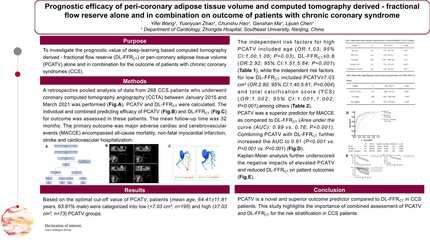
Coronary computed tomography angiography (CCTA) is a helpful tool in diagnosing coronary artery disease (CAD). Noninvasive imaging markers like peri-coronary adipose tissue volume (PCATV) and Computed Tomography Derived Fractional Flow Reserve (FFRCT) have attracted significant attention due to their prognostic potential.
To investigate the prognostic value of deep-learning based FFRCT (DL-FFRCT) and PCATV alone and in combination for outcome of patients with chronic coronary syndromes (CCS).
A retrospective pooled analysis of data from 268 CCS patients who underwent CCTA between January 2015 and March 2021 was performed. PCATV and DL-FFRCT were calculated. The individual and combined predicting efficacy of PCATV and DL-FFRCT for outcome was assessed in these patients. The mean follow-up time was 32 months. The primary outcome was major adverse cardiac and cerebrovascular events (MACCE) encompassed all-cause mortality, non-fatal myocardial infarction, stroke and cardiovascular hospitalization.
Based on the optimal cut-off value of PCATV, patients (mean age, 64.41±11.81 years, 63.81% male) were categorized into low (<7.03 cm³, n=195) and high (≥7.03 cm³, n=73) PCATV groups. The independent risk factors for high PCATV included age(OR:1.03; 95% CI:1.00,1.06; P=0.03), DL-FFRCT≤0.8 (OR:2.92; 95% CI;1.51,5.64; P=0.001), while the independent risk factors for low DL-FFRCT included PCATV≥7.03 cm³(OR:2.80; 95% CI:1.40,5.61; P=0.004) and total calcification score (TCS) (OR:1.002; 95% CI:1.001,1.002; P<0.001),among others. PCATV was a superior predictor for MACCE as compared to DL-FFRCT (AUC: 0.89 vs. 0.76; P<0.001). Combining PCATV with DL-FFRCT further increased the AUC to 0.91 (P<0.001 vs. P<0.001 vs. P<0.001). Kaplan-Meier analysis further underscored the negative impacts of elevated PCATV and reduced DL-FFRCT on patient outcomes.
PCATV is a novel and superior outcome predictor compared to DL-FFRCT in CCS patients. This study highlights the importance of combined assessment of PCATV and DL-FFRCT for the risk stratification in CCS patients.
Graphical Abstract

You may be interested in