Effect of coronary calcium-informed statin therapy on peri-coronary adipose tissue attenuation in intermediate-risk patients: post-hoc analysis of the CAUGHT-CAD randomised-controlled trial
European Heart Journal


Abstract
Peri-coronary adipose tissue (PCAT) attenuation has been associated with high-risk plaque and cardiac mortality. Serial assessment of PCAT and changes with therapy have not been prospectively evaluated.
To evaluate the change in PCAT attenuation in patients with coronary artery plaque treated with a strategy of statin and lifestyle therapy, and the association with change in plaque progression.
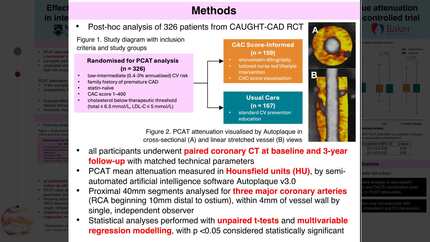
We performed a post-hoc analysis of the randomised-controlled CAUGHT-CAD trial. Asymptomatic, statin-naïve individuals with low-intermediate 5-year risk of cardiovascular disease, and a family history of premature coronary artery disease underwent paired coronary computed tomography at baseline and 3-year follow-up. Participants were randomised to a coronary artery calcium score (CACS) informed prevention arm (atorvastatin 40mg/daily and nurse-led tailored lifestyle intervention), and a usual care arm (general lifestyle advice). PCAT attenuation was measured in Hounsfield units (HU) along the proximal segment of all three major coronary arteries, and coronary plaque volume was quantified using semi-automated software.
326 patients (mean age 58.6 ± 6.9 years) were analysed; 159 in CACS-informed and 167 in usual care groups. CACS-informed individuals demonstrated significant and sustained reductions in total and low-density lipoprotein cholesterol, driving a reduction in pooled cohort equation risk score. There was no significant difference in 3-year PCAT attenuation change between CACS-informed and usual care groups, in either the right coronary artery (4.9 ± 11.3 vs 4.8 ± 12.2 HU, p = 0.94) or 3-vessel average (4.5 ± 9.2 vs 4.9 ± 11.3 HU, p = 0.76). Compared to usual care, CACS-informed individuals demonstrated a lesser total plaque progression (16.4 ± 29.1 vs 25.5 ± 38.4 mm3, p = 0.017). Neither baseline nor 3-year change in PCAT attenuation significantly predicted plaque progression (baseline: β = 0.04, p = 0.79; change: β = 0.18, p = 0.28).
Despite reductions in lipid levels, risk prediction scores and lesser plaque progression, a CACS-informed strategy of statin therapy with tailored lifestyle intervention did not have any effect on change in PCAT attenuation.
Contributors

N Tan
Author
S Vasanthakumar
Author
V Goel
Author
E Aldous
Author
A Lin
Author
S Nicholls
Author
T Marwick
Author
N Nerlekar
Author
You may be interested in