Coronary calcium score in primary prevention: clinical characteristics and segmental distribution from an Argentine clinic registry
European Heart Journal


Abstract
Coronary artery calcium, quantified through the Coronary Calcium Score (CCS), is an independent predictor of coronary events and a key marker of subclinical atherosclerosis and cardiovascular risk (CVR). While calcium distribution offers prognostic information, no local data exists in Argentina, underscoring the need for research to improve CVR stratification.
To evaluate calcium distribution, its association with cardiovascular risk factors (CVRFs), and segmental involvement in asymptomatic patients without cardiovascular disease undergoing CCS assessment.
A retrospective study of primary prevention patients undergoing CCS at an Argentine institution between March 2022 and January 2025. Clinical data were obtained through self-report and Electronic Health Records. Non-contrast cardiac CT was performed, with CCS measured in Agatston units (AU). Patients were stratified into CCS= 0 or CCS≥ 1. Calcium distribution was assessed in the left anterior descending (LAD), circumflex (CX), right coronary (RCA), and left main coronary (LMCA) arteries, with segmental analysis (proximal, mid, distal). Results were categorized into three CCS groups: 1–99AU, 100–299AU, and >300AU.
A total of 993 patients were evaluated, with a mean age of 56 ± 9.9 years; 53.2% were male. CVRF prevalence included overweight (41.7%), obesity (18%), hypertension (37.3%), dyslipidemia (65.5%), smoking (17.1%), diabetes (4%), and sedentary lifestyle (31.7%). CCS analysis revealed 57% had CCS=0 (n=566), while 43% had CCS≥1 (n=427). The CCS≥ 1 group was older (60.03 ± 9.34 vs. 53.08 ± 9.41 years, p< 0.001), had more males (68.9% vs. 41.3%, p <0.001), and higher prevalence of obesity (23.0% vs. 14.3%, p =0.001), hypertension (48.2% vs. 29.0%, p <0.001), dyslipidemia (74.7% vs. 58.5%, p <0.001), and diabetes (6.6% vs. 2.1%, p =0.001) (Table 1).
Segmental analysis showed proximal LAD involvement in 71.9%, mid LAD in 69.1%, and proximal CX in 34.9%. RCA involvement was 26.2%, and LMCA 16.9%. The distal CX was least affected (7.1%).
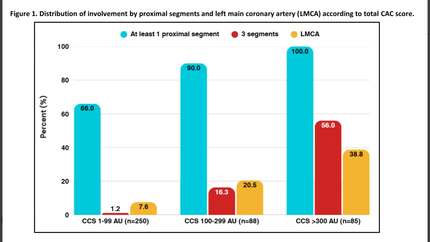
In the 1–99AU group (59%, n=250), proximal involvement was 66.4%, with 1.2% showing three segments involved and 7.6% LMCA calcification. In the 100–299AU group (21%, n= 88), proximal involvement increased to 89.5%, with 16.3% showing all three segments involved. The >300AU group (20%, n=85) had 100% proximal involvement and 38.8% LMCA calcification. Intergroup differences were significant (p <0.001) (Figure1).
This Argentine registry confirms that coronary calcium correlates with higher-risk profiles. Segmental analysis shows a progressive pattern: as the CCS increases, involvement of proximal segments and LMCA also rises, underscoring its prognostic significance. These findings provide essential local data that emphasize the importance of integrating both the total CCS and its distribution into CVR re-stratification and the development of personalized prevention strategies.
Contributors

P Kuschnir
Author

A Sciancalepore
Author
M Corneli
Author
M Herrasti
Author
M Conde
Author
P Cardozo
Author
E A Lopez
Author
P Elissamburu
Author
G Perea
Author
H D Sanabria
Author
You may be interested in