A novel artificial intelligence-powered framework for predicting coronary artery calcium score from non-gated computed tomography
European Heart Journal


Abstract
Coronary artery calcium (CAC) scores calculated from electrocardiogram (ECG)-gated CT scans, typically assessed using the Agatston scores, are the most reliable markers of cardiovascular risk, particularly in asymptomatic individuals. Recent advances in artificial intelligence (AI) in cardiovascular imaging have enabled fully automated CAC scoring using ECG-gated CT scans. However, there is little evidence on the prediction of CAC scores from non-gated CT, which is widely used in clinical practice.
The aim of this study is to develop and validate a fully automated AI framework for estimating CAC scores from non-gated CT images.
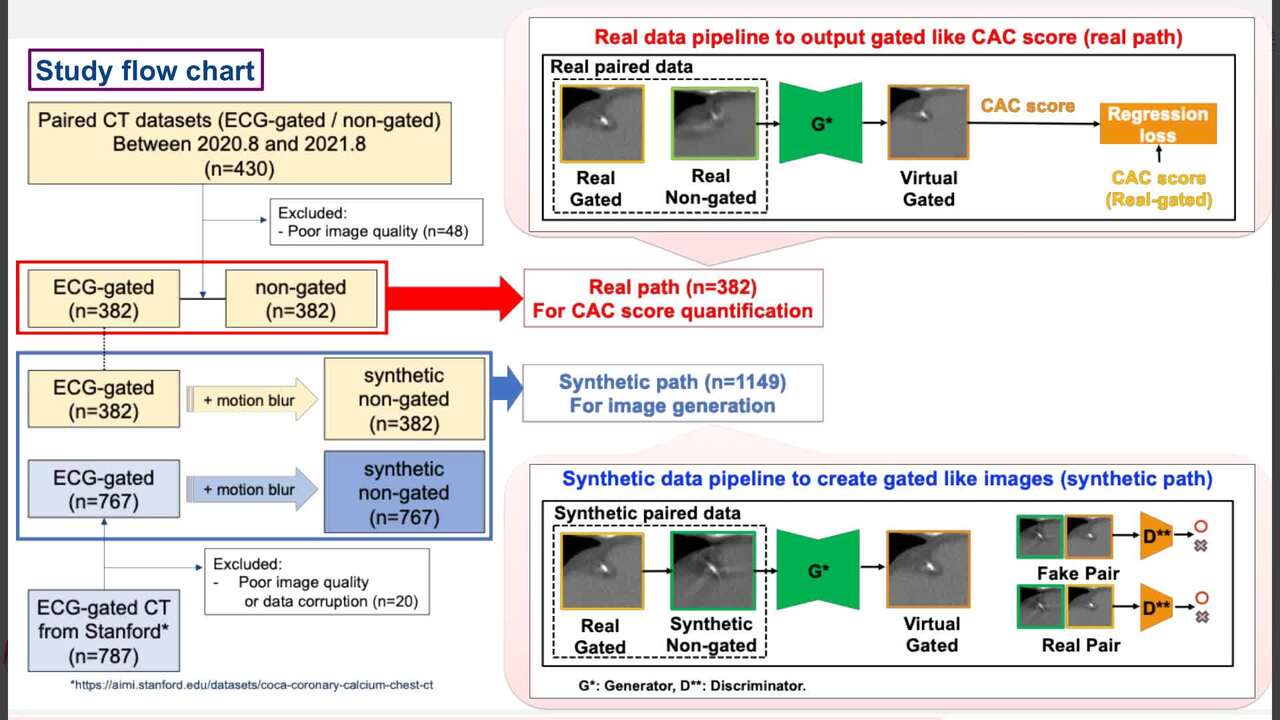
We proposed an end-to-end, interpretable AI approach for CAC scoring from non-gated CT images. First, a generative adversarial network was trained to convert non-gated CT images into ‘virtual gated’ images resembling ECG-gated scans. Next, CAC scores were automatically quantified from the virtual gated images using a previously validated AI model. The training dataset included 382 pairs of real scans (gated and non-gated). To expand the dataset, synthetic non-gated CT images were generated from an additional 767 gated scans, resulting in a total of 1,149 pairs of gated and non-gated scans images. Model performance was evaluated using two independent cohorts (n=192 and n=163), where AI-predicted CAC scores from non-gated CT scans were compared to the corresponding real ECG-gated CT scans, as reference standard.
The AI framework demonstrated moderate to substantial agreement in CAC risk categorization, with Cohen’s Kappa values of 0.57 (p<0.0001) and 0.65 (p<0.0001), respectively. For detecting CAC scores greater than 100 which is recommended in guidelines as a criterion for initiating statin therapy, the model achieved a sensitivity of 87.7% and 87.2%, a specificity of 93.3% and 96.5%, and a F1-score of 0.850 and 0,904 respectively. Linear regression models also showed excellent correlations between AI-predicted CAC and real ECG-gated CAC (r=0.9686, p<0.0001; r=0.9235, p<0.0001, respectively).
This AI-based framework enables CAC scoring from non-gated CT images, potentially facilitating widespread cardiovascular risk assessment and early preventive intervention.
Contributors

S Fujimoto
Author
D Takahashi
Author
Y O Kawaguchi
Author
A Kudo
Author
T Aikawa
Author
K Takamura
Author
M Hiki
Author
N Tomizawa
Author
H Daida
Author
T Minamino
Author
You may be interested in