Novel lesion-level coronary artery calcium characterization from non-contrast computed tomography
European Heart Journal


Abstract
Current CAC quantification methods aggregate imaging data or do not account for calcium density, leading to a loss of resolution. There is a paucity of CAC quantification methods that can capture information such as plaque heterogeneity that may be more indicative of vulnerability.
We aim to introduce novel, pixel-based methods of CAC quantification obtained directly from the non-contrasted CT images.
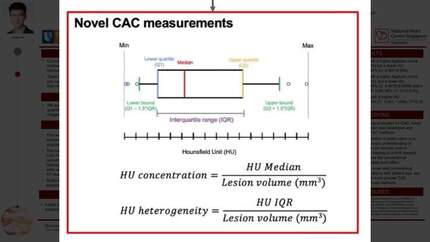
This was a single-center, retrospective cohort study of symptomatic patients referred for both coronary CT angiography and CAC scans. The conventional Agatston score, along with two novel CAC measures, namely Hounsfield unit (HU) concentration (HU median/Lesion volume) and HU heterogeneity (HU interquartile range/Lesion volume), were calculated on a per-lesion basis from non-contrast CT (Figure 1). Multivariate logistic regression was used to assess their associations with risk factors and statin use.
A total of 2055 CAC lesions from 258 patients were analyzed (mean age 58.4 ± 10.2 years, 35.7% female). Age ≥ 55 was associated with a higher Agatston score (Odds Ratio [OR]: 1.10; 95% Confidence Interval [CI]: 1.03-1.19) but a lower HU concentration (OR: 0.998; 95% CI: 0.997-0.999). Male sex was associated with a higher Agatston score (OR: 1.09; 95% CI: 1.01-1.18), but a lower HU concentration (OR: 0.999; 95% CI: 0.9975-0.9998) and a lower HU heterogeneity (OR: 0.96; 95% CI: 0.93-0.99). Statin use was associated with a higher HU concentration (OR 1.002, 95% CI: 1.001, 1.004) (p<0.05 for all, Table 1).
In symptomatic patients being evaluated for CAD, novel, pixel-based CAC quantification was developed and compared to conventional CAC methods. The increase in HU concentration in statin users is in congruent with the contemporary understanding of statin therapy reducing lipid-rich necrotic core in atherosclerotic plaques and leading to a shift toward high-density calcium, whereas the conventional Agatston score fails to elucidate such effect. Discrepancies between the novel and conventional methods observed in associations with patient age, sex and statin usage may be reflective of more precise CAC measures captured by the novel methods.


You may be interested in