Video-based deep learning can estimate coronary artery calcium score using echocardiography in patients with chronic kidney disease
European Heart Journal


Abstract
Video-based deep learning (DL) is a promising artificial intelligence tool in echocardiography.
To estimate coronary artery calcium score (CACS) using echocardiography and DL in patients with chronic kidney disease (CKD). Furthermore, to test the prognostic value of estimated CACS in the general population.
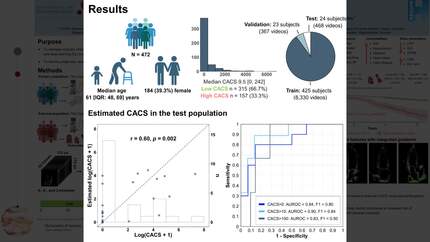
The study population consisted of subjects from the CPH-CKD study who had undergone echocardiography and, within a year of this, a cardiac computed tomography scan to assess CACS. These subjects were partitioned into a train, validation and test subpopulation. A convolutional neural network based on an R(2+1)D architecture was trained to predict log(CACS+1) (Figure 1). Log-transformation was applied due to a skewed distribution. The videos used as inputs for the DL model included the apical 4-, 2-, and 3-chamber views. Multiple videos were used per person, and for inference, predicted values were averaged over all videos per person. For this study, a measured CACS above 100 Agatston units or a predicted value corresponding to this was denoted high, while a value below was denoted low. To assess the prognostic value of the trained model against all-cause death and acute myocardial infarction (MI) in an external general population, CACS was predicted on subjects from the Copenhagen City Heart Study (CCHS). Uni- and multivariable Cox regression was performed, and the latter was adjusted for age, sex, ischemic heart disease, BMI, ever smoking, diabetes, hypertension, and left ventricular ejection fraction. In addition, subjects from the CCHS were stratified according to high or low predicted CACS, and a Kaplan-Meier curve was plotted along with results of univariable Cox regression.
The CKD study population included 472 patients (9,170 videos available), of whom 425 (8,330 videos) were used for training, and 23 (370 videos) and 24 (470 videos) were used for validation and test, respectively. In the test population, predicted CACS correlated well with measured CACS (r = 0.60, p = 0.002) and discriminated well between a high or low measured CACS (area under receiver operating characteristics curve of 0.84). Out of a total of 4,391 subjects from the CCHS with 19,590 videos available, 282 (6.4%) subjects died and 70 (1.6%) developed MI over a median follow-up period of 5.4 (IQR: 4.5-6.3) years. Higher predicted CACS was associated with a higher mortality (HR=1.73 (95%CI 1.62-1.86) per unit increase, p<0.0001) and higher risk of MI (HR=1.55 (95%CI 1.36-1.76), p<0.0001). In adjusted analysis, the association persisted with mortality (HR=1.12 (95%CI 1.01-1.24), p=0.04), but not MI. Subjects with a high predicted CACS had a significantly increased risk of all-cause death (Figure 2).
Video-based DL can be trained to estimate CACS using echocardiography in patients with CKD. These estimates might help identify individuals at increased risk of coronary calcification and adverse outcomes. Overview Kaplan-Meier curve
Contributors

J Christensen
Author
N E Landler
Author

I M H Soerensen
Author
S S Bjergfelt
Author
C Christoffersen
Author
S Bro
Author
G B Jensen
Author
K F Kofoed
Author
P Schnorr
Author
T Biering-Soerensen
Author
You may be interested in