Cardiac magnetic resonance-derived left atrioventricular coupling index for prognostic stratification in patients with reduced ejection fraction: insights from the DERIVATE Registry
European Heart Journal


Abstract
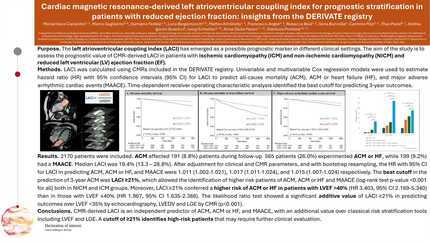
The left atrioventricular coupling index (LACI), defined as the ratio between left atrial end-diastolic volume (LAEDV) and left ventricle end-diastolic volume (LVEDV), has emerged as a possible prognostic marker in different clinical settings.
To assess the prognostic value of CMR-derived LACI in patients with ischemic cardiomyopathy (ICM) and non-ischemic cardiomyopathy (NICM) and left ventricular (LV) ejection fraction (EF) <50%.
LACI was calculated using CMRs of patients included in the DERIVATE registry, enrolling subjects with LVEF<50%. Univariable and multivariable Cox regression models were used to estimate the hazard ratio (HR) with 95% confidence intervals (95% CI) for LACI to predict all-cause mortality (ACM), ACM or heart failure (HF), and major adverse arrhythmic cardiac events (MAACE). Time-dependent receiver operating characteristic analysis was performed to identify the best cutoff for predicting 3-year outcomes. Likelihood ratio test was used to assess the additive value of LACI over LVEF <35% and other clinical and instrumental prognosti stratification tools.
2170 patients were included. The median follow-up time was 1016 days (25th-75th percentiles: 580.3 – 1609.5 days). ACM affected 191 (8.8%) patients during follow-up. 565 patients (26.0%) experimented ACM or HF, while 199 (9.2%) had a MAACE. Median LACI was 19.4% (13.3 – 28.8%). After adjustment for clinical (including age, sex, cardiovascular risk factors, NYHA class, AF, ischaemic aetiology of HF) and CMR parameters (as LV dimensions, LVEF, and late gadolinium enhancement (LGE)) and with bootstrap resampling, the HR with 95% CI for LACI in predicting ACM, ACM or HF, and MAACE were 1.011 (1.002-1.021), 1.017 (1.011-1.024), and 1.015 (1.007-1.024) respectively. The best cutoff in the prediction of 3-year ACM was LACI ≥21%. This cutoff allowed the identification of patients at higher risk of ACM, ACM or HF and MAACE (log-rank test p-value <0.001 for all) both in NICM and ICM groups. Moreover, LACI ≥21% conferred a higher risk of ACM or HF in patients with LVEF >40% (HR 3.403, 95% CI 2.169-5.340) than in those with LVEF ≤40% (HR 1.967, 95% CI 1.635-2.366). The likelihood ratio test showed a significant additive value of LACI ≥21% in predicting outcomes over LVEF <35% by echocardiography, LVEDV, and LGE by CMR (p<0.001).
CMR-derived LACI is an independent predictor of ACM, ACM or HF, and MAACE, with an additional value over classical risk stratification tools including LVEF and LGE. A cutoff of ≥21% identifies high-risk patients that may require further clinical evaluation. Kaplan-Meier for LACI stratification Likelihood ratio test
Contributors

M Ciarlantini
Author
M Guglielmo
Author
D Fedele
Author
F Angeli
Author
I Buccella
Author
L Fusini
Author
A Volpe
Author
S Mushtaq
Author
A Baggiano
Author
T Pezel
Author
A I Guaricci
Author
J Schwitter
Author
A G Pavon
Author
G Pontone
Author
You may be interested in