Three-dimensional echocardiography characterisation of right atrial appendage anatomy and function is feasible in patient with atrial fibrillation
European Heart Journal


Abstract
Right atrial appendage (RAA) is an important substrate for the maintenance of AF, and its role is often neglected. Few studies have described RAA morphology.
We hypothesized that three-dimensional (3D) transoesophageal echocardiography (TEE) could characterise RAA anatomy and function in patients with atrial fibrillation (AF).
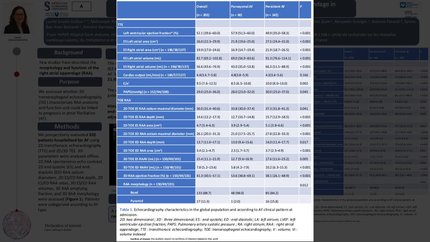
We prospectively evaluated 202 patients hospitalized for AF using two-dimensional (2D) transthoracic (TTE) and 2D/three-dimensional (3D) TEE. 3D parameters were off-line analysed using Ultrasound Workspace software (4D Cardio-View, Philips). Dedicated measurements of the RAA were obtained in 2D TEE at 120° and in 3D TEE. Spontaneous contrast, sludge, end-systolic (ES) and end-diastolic (ED) measurements of 2D RAA ostium diameter, 2D RAA height, 2D RAA area, 3D RAA volume were measured (Figure 1A). We calculated also 3D RAA emptying fraction defined by (3D ES RAA volume-3D ED RAA volume) / 3D ES RAA volume.
Mean age was 66±11 years and 126 (62%) patients were male. The median of CHA2DS2-VASc score was 3 (2-4). Sixty (30%) patients had paroxysmal AF, 139 (69%) persistent AF and 3 (1%) permanent AF. RAA spontaneous echo contrast (SEC) of the RAA was present in 39(19%) grade 1, 20(10%) grade 2, 7(3%) grade 3, 4(2%) sludge; 132(65%) patients had no RAA SEC.The median of 2D ES RAA area was 4.7 (3.4-6.3)cm2, 3D ES RAA volume was 15.4(11.1-21.9)ml, and 3D RAA emptying fraction 41.3(30.5-57.1)% . Main 2D TTE and 2D/3DTEE measurements are displayed in Table 1A. We studied the correlation between 3D RAA volume and 2D RA volume, 3D LAA volume. We found a correlation between 3D ED RAA volume and 2D RA volume (r=0.416) and between 3D ED RAA volume and 3D ED LAA volume (r=0.478) (Table 1B).
A novel 3D echocardiographic approach can determine the geometry, size, and function of the RAA in AF patients. RAA remodeling in AF patients could have some interest in the characterization of atrial cardiomyopathy.
Contributors


E Sotto
Author
E Patte
Author
M Chauvet-Droit
Author
J Reisberg
Author
P A Le Bos
Author
L Benoudiba-Campanini
Author
C Boivineau
Author
N Ferrouk
Author
E Capderou
Author
I Benhamou-Tarallo
Author

A Cohen
Author
You may be interested in