Predicting exercise pulmonary hypertension: the RIGHT-NET machine learning model
European Heart Journal


Abstract
Exercise pulmonary hypertension (PH) has been invasively defined as mean pulmonary artery pressure (mPAP)/cardiac output (CO) slope > 3 mmHg/L.min between rest and exercise. Exercise transthoracic Doppler echocardiography (TTE)-determination of mPAP/CO slope, irrespective of its relation to invasive pressures, may provide major diagnostic and prognostic information in different clinical scenarios.
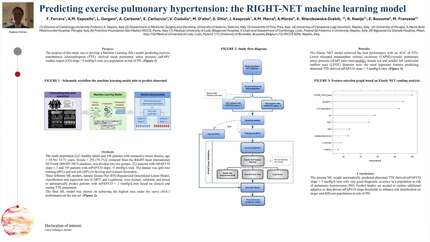
The purpose of this study was to develop a ML model predicting exercise TTE-derived mPAP/CO slope > 3 mmHg/L.min in a population at risk of PH. (Figure 1)
The study population [221 healthy adults and 196 patients with connective tissue disease; age = 54.56 ± 14.73 years; female = 293 (70.3%)] extracted from the RIGHT heart international NETwork (RIGHT-NET) database, was divided into two groups: 222 patients with mPAP/CO slope ≤ 3 and 195 patients with mPAP/CO slope >3 mmHg/L.min. The dataset was split into training (60%) and test sets (40%) to develop and evaluate the models. Three different ML models, namely Elastic-Net (EN) Regularized Generalized Linear Model, classification and regression tree (CART) and Logitboost, were trained, validated, and tested to automatically predict patients with mPAP/CO > 3 mmHg/L.min based on clinical and resting TTE parameters. The final ML model was chosen on achieving the highest AUC (area under the curve) performance on the test set (Figure 2a).
The Elastic NET model achieved the best performance with an AUC of 92%. Lower tricuspid annular plane systolic excursion (TAPSE)/systolic pulmonary artery pressure (sPAP) ratio (mm/mmHg), female sex and smaller left ventricular outflow tract (LVOT) diameter were the most important features predicting abnormal TTE-derived mPAP/CO slope > 3 mmHg/L/min (Figure 2b).
The present ML model automatically predicted abnormal TTE derived-mPAP/CO slope > 3 mmHg/l.min with very good diagnostic accuracy in a population at risk of PH. Further studies are needed to explore additional adaptive or data-driven mPAP/CO slope thresholds to enhance risk stratification on larger and different populations at risk of PH.
Contributors


L Gargani
Author

V Codullo
Author

J Kasprzak
Author
A M Marra
Author
A Moreo
Author


E Bossone
Author
M Franzese
Author
You may be interested in