Study on the prognostic value of dandel's index in elevated pulmonary artery pressure and long-term outcomes in heart failure with preserved ejection fraction (HFpEF)
European Heart Journal


Abstract
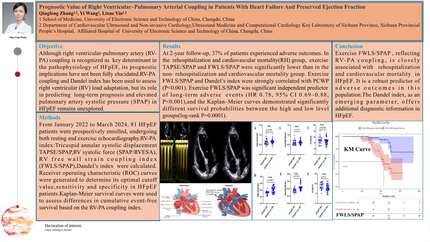
Elevated pulmonary artery pressure (PAP) is common in heart failure with preserved ejection fraction (HFpEF) and serves as a strong predictor of adverse outcomes. The Dandel index has been used to assess right ventricular (RV) load adaptation, but its role in predicting elevated PAP and long-term prognosis in hypertension-related HFpEF remains unexplored.
From January 2022 to March 2023, 86 HFpEF patients were prospectively enrolled, undergoing both resting and exercise echocardiography. Dandel’s index, tricuspid annular systolic displacement (TAPSE) / pulmonary artery systolic pressure (PASP), RV systolic force (PASP/RVESA), RV free wall strain coupling index (RVFWLS/PASP), and tricuspid annular systolic velocity (TAS') / PASP were calculated. Receiver operating characteristic (ROC) curve analysis was used to identify the optimal cutoff points for TAPSE/PASP, RVFWLS/PASP, and Dandel’s index to distinguish HFpEF patients with elevated pulmonary capillary wedge pressure (PCWP) from those without.
At 2-year follow-up, 37% of patients experienced adverse cardiovascular events. In the pulmonary hypertension group, both resting and exercise TAPSE/PASP and RVFWLS/PASP were significantly lower than in the non-pulmonary hypertension group. Resting/exercise RVFWLS/PASP and Dandel’s index were strongly correlated with PCWP (P<0.001). Dandel’s index was significant independent predictor of long-term cardiovascular events (HR 0.73, 95% CI 0.59–0.81, P<0.001).
Dandel's index, reflecting RV-PA coupling, is closely associated with abnormal hemodynamics in HFpEF, particularly elevated PCWP. It is a robust predictor of adverse cardiovascular events in this population.
Contributors



You may be interested in