Machine learning-based identification of clinical phenotypes and prognostic stratification in ANOCA patients
European Heart Journal


Abstract
Angina with non-obstructive coronary arteries (ANOCA) is a common clinical syndrome, particularly prevalent among middle-aged and elderly populations. Recent evidence suggests significant clinical heterogeneity among ANOCA patients, highlighting the need for improved phenotypic characterization and risk stratification.
This study aimed to utilize multiple parameters from adenosine-stress echocardiography, including coronary flow reserve (CFR) and cardiac functional changes, to identify distinct clinical subtypes through unsupervised clustering and evaluate their prognostic value.
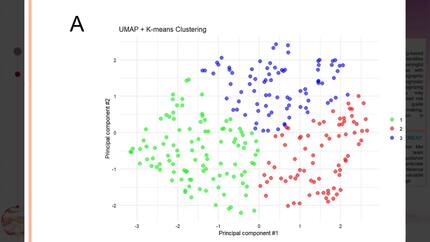
We retrospectively analyzed 267 patients diagnosed with ANOCA who underwent adenosine-stress echocardiography. Using unsupervised machine learning (Uniform Manifold Approximation and Projection [UMAP] combined with K-means clustering), we identified distinct patient clusters based on echocardiographic parameters, including coronary flow characteristics and cardiac function. The primary outcome was major adverse cardiovascular events (MACEs), defined as all-cause mortality, myocardial infarction, or hospitalization for heart failure. Differences in MACEs among clusters were evaluated using log-rank tests.
Three distinct subtypes (Cluster 1: n=106; Cluster 2: n=78; Cluster 3: n=83) were identified among the 267 ANOCA patients, with significant differences in cumulative MACE incidence during follow-up (log-rank P=0.02) (Figures1 A. B). Cardiac structural parameters were similar across the three clusters. However, Cluster 1 patients were older, predominantly female, had poorer left ventricular function at rest and during stress, and exhibited the highest MACE incidence. Cluster 2 and Cluster 1 had similar CFVR levels, but Cluster 2 showed relatively preserved cardiac function at rest. Cluster 3, predominantly male, demonstrated significantly higher CFVR, better myocardial functional reserve under stress, and the most favorable prognosis (Figures1 C.D). Further analysis revealed that the clustering model incorporating cardiac function and coronary flow characteristics provided better prognostic discrimination compared to models based solely on CFVR (Figure1 E).
Machine learning-based clustering identifies clinically meaningful ANOCA phenotypes with distinct echocardiographic profiles and prognostic implications. Recognizing these phenotypes may enhance individualized risk stratification and guide clinical decision-making, pending validation in prospective studies.

You may be interested in