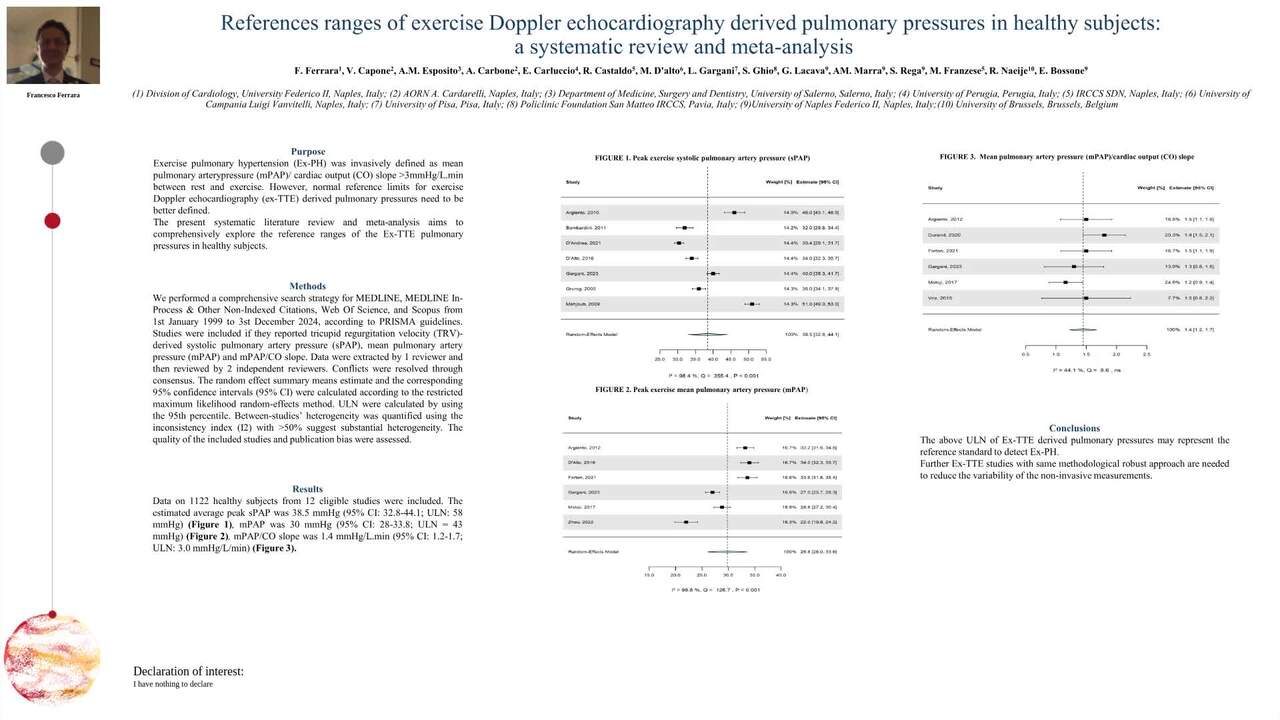
References ranges of exercise Doppler echocardiography derived pulmonary pressures in healthy subjects: a systematic review and meta-analysis
European Heart Journal


Abstract
Exercise pulmonary hypertension (Ex-PH) was invasively defined as mean pulmonary artery pressure (mPAP)/ cardiac output (CO) slope >3mmHg/L/min between rest and exercise. Supine/semi-recumbent exercise transthoracic Doppler echocardiography (Ex-TTE) (noninvasive, widely available and sustainable) is increasingly used for the detection of Ex-PH and prognostication. However, upper limits of normal (ULN) of Ex-TTE- derived pulmonary pressures are not well established.
The present systematic literature review and meta-analysis aims to comprehensively explore the reference ranges of the Ex-TTE derived-pulmonary pressures in healthy subjects.
We performed a comprehensive search strategy for MEDLINE, MEDLINE In-Process & Other Non-Indexed Citations, Web Of Science, and Scopus from 1st January 1999 to 3st December 2024, according to PRISMA guidelines. Studies were included if they reported tricupid regurgitation velocity (TRV)- derived systolic pulmonary artery pressure (sPAP), mean pulmonary artery pressure (mPAP) and mPAP/cardiac output (CO) slope. Data were extracted by 1 reviewer and then reviewed by 2 independent reviewers. Conflicts were resolved through consensus. The random effect summary means estimate and the corresponding 95% confidence intervals (95% CI) were calculated according to the restricted maximum likelihood random-effects method. ULN were calculated by using the 95th percentile. Between-studies’ heterogeneity was quantified using the inconsistency index (I2) with >50% suggest substantial heterogeneity. The quality of the included studies and publication bias were assessed.
Data on 1230 healthy subjects from 14 eligible studies were included. The estimated average peak sPAP was 39 mmHg (95% CI:35-43; ULN: 60 mmHg) (Figure 1a), mPAP was 28 mmHg (95% CI: 23-32; ULN = 40 mmHg) (Figure 1b), mPAP/CO slope was 1.5 mmHg/L.min (95% CI: 1-4-1.7; ULN: 3 mmHg/L.min) (Figure 2).
The above ULN of Ex-TTE derived pulmonary pressures may represent the reference standard to detect Ex-PH. Further Ex-TTE studies with same methodological robust approach are needed to reduce the variability of the non-invasive measurements.
Contributors



R Castaldo
Author

L Gargani
Author
G Lacava
Author
A M Marra
Author
M Franzese
Author

E Bossone
Author
You may be interested in