Identification of ANOCA endotypes by stepwise, multi-stress, multi-marker stress echocardiography: necessity of noninvasive approach
European Heart Journal


Abstract
Angina with non-obstructive coronary artery disease (ANOCA) is increasingly recognized in clinical practice but effective therapy is difficult to apply due to the heterogeneity of pathophysiological substrates: structural coronary microvascular dysfunction (CMD), functional (vasospastic) CMD, epicardial artery vasospasm, non-cardiac chest pain. Current guidelines recommend invasive coronary function testing with inherent limitations in cost, risk, and access.
To evaluate the feasibility of a step-wise, multi-marker, multi-stress assessment of ANOCA patients by stress echocardiography (SE).
In an observational, prospective, multicenter, international study, we enrolled 1146 ANOCA patients (age =65.6±11.6years, 636 men, 55, %). All patients underwent a vasodilator SE (adenosine or dipyridamole) with coronary flow velocity reserve (CFVR) measurement in the mid-distal left anterior descending artery (LAD). In a subset of patients with a normal CFVR and strong clinical suspicion for vasospasm, a hyperventilation (HYPER) test (30 deep breaths/min for 5 min) was performed, followed by semi-supine exercise (EX) if negative. Positivity criteria were stress-specific: CFVR < 2.0 for vasodilators; coronary flow velocity (CFV) reduction ≤ 10% from baseline with HYPER; inducible RWMA 2.for HYPER and HYPER-EX
Of the 1146 patients, 244 (21%) showed abnormal CFVR i.e. structural CMD (Figure 1). In the subset of 68 patients with normal vasodilator CFVR , entering a strategy of sequential stepwise approach, 40 pts underwent HYPER showing a paradoxical vasoconstrictor response despite the increase in the double product (59 %), with RWMA in 11 (16%). Of the remaining patients with normal CFVR and normal response to HYPER, 28 underwent HYPER-EX showing inducible RWMA in 7 (10%) patients. The remaining 21 patients (31%) showed all 3 tests normal: see figure 2.
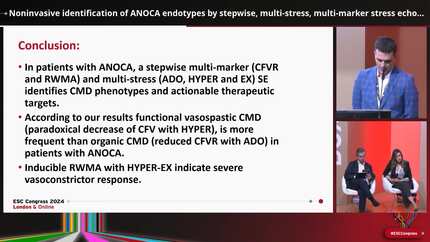
In patients with ANOCA, a stepwise multi-marker (CFVR and RWMA) and multi-stress (vasodilators, HYPER, and EX) SE identifies 4 distinct phenotypes and actionable therapeutic targets: structural CMD (reduced CFVR with vasodilator); functional vasospastic CMD (paradoxical decrease of CFV with HYPER), epicardial artery vasospasm (inducible RWMA with HYPER or HYPER-EX); non-cardiac chest pain with normal response all tests and all markers. Our research emphasizes the usefulness of versatile, patient-tailored noninvasive testing in patients with ANOCA to unmask the functional heterogeneity of the endotypes underlying the same phenotype.
Figures:
1. Overall population of ANOCA (N=1146)-vasodilator CFVR
2. Pilot study in ANOCA with CFVR>2.0 (N=68) Overall population of ANOCA (N=1146) Pilot study in ANOCA with CFVR>2.0
Contributors


S Dedic
Author
Q Ciampi
Author
N Boskovic
Author
V Giga
Author
M Tesic
Author
C Borguezan-Daros
Author
H Rodriguez-Zanella
Author
L Cortigiani
Author
A Zagatina
Author
A Boshchenko
Author
J Celutkiene
Author
K Wierzsbowska-Drabik
Author
P Pellikka
Author
E Picano
Author
You may be interested in