Right ventricular-pulmonary circulation uncoupling during exercise is associated with ventilatory inefficiency, enhancing the prediction of clinical outcomes
European Heart Journal


Abstract
Both the TAPSE/PASP and MPAP/CO slope are indicators of right ventricular to pulmonary circulation uncoupling during exercise that reflect basic pathophysiology of cardiac disorders. Ventilation inefficiency during maximal exercise is a strong prognosticator.
The relationship between these parameters and exercise ventilatory inefficiency has not been clearly established in patients with cardiac disorders neither their synergic definition of clinical outcome.
A total of 140 heart failure (HF) patients (26 HFpEF, 28 HFmrEF, 86 HFrEF), 50 patients with aortic stenosis (AS), 69 patients with primary mitral regurgitation (PMR), and 59 subjects with non-cardiogenic dyspnea (NCD: EF >50% and exercise E/e' <15) underwent cardiopulmonary exercise testing with exercise echocardiography. HF hospitalization or all-cause mortality was defined as clinical events, with a median follow-up period of 871 days (IQR 422–1680).
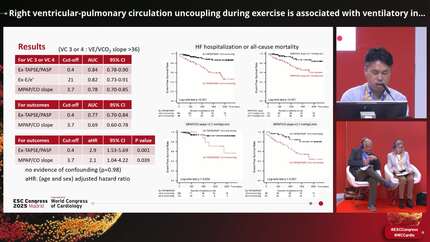
Exercise TAPSE/PASP was significantly lower in the AS, PMR, and HF groups compared to the NCD group, with the HF group showing the lowest values among the four groups (figure 1A). MPAP/CO slope was significantly higher in the AS, PMR, and HF groups compared to the NCD group (figure 1B). Ventilatory classification (VC) 3 or 4 (VE/VCO2 slope >36 and >44) was observed in 26.4% in HF, 6.0% in AS, 5.8% in PMR, and 3.4% in NCD group, respectively. The clinical event rates in each group were 32.8%, 17%, 5.2%, and 0%, respectively. For predicting VC 3 or 4, exercise TAPSE/PASP demonstrated the highest predictive value with a cutoff of 0.4, yielding an AUC of 0.842 (95% CI: 0.782–0.903), followed by MPAP/CO slope with a cutoff of 3.7 (AUC: 0.776, 95% CI: 0.703–0.849). Both exercise TAPSE/PASP and MPAP/CO slope predicted patient events at the cutoffs derived from the prediction of VC 3 or 4 (figure 2). After adjusting for age and sex, a Cox regression analysis using both indicators revealed that they independently predicted prognosis (exercise TAPSE/PASP <0.4, HR 2.9, 95%CI 1.53-5.69, p=0.001; MPAP/CO slope >3.7, HR 2.1, 95%CI 1.04-4.22, p=0.039), without confounding (p=0.98).
Exercise TAPSE/PASP and MPAP/CO slope, both indices of right ventricular to pulmonary circulation coupling during exercise, predict ventilatory inefficiency and patient outcomes in cardiac disorders. Their combined assessment enhances the predictive accuracy for adverse events.
Contributors


You may be interested in