Right chambers' strain in arrhythmogenic right ventricular cardiomyopathy
European Heart Journal


Abstract
Right ventricular free wall strain (RV FWS) has been shown to be associated with outcome in patients with Arrhythmogenic Right Ventricular Cardiomyopathy (ARVC). However, only few studies have explored the prognostic value of right atrial (RA) reservoir strain (RASr) in these patients, particularly when combined with RV FWS measures.
To evaluate the prognostic value of combining RASr and RV FWS in patients with ARVC.
Patients who met the revised 2010 Task Force Criteria for possible, borderline and definite ARVC diagnosis were included. Both RASr and RV FWS were measured at baseline, along with left ventricular global longitudinal strain (LV GLS) and left atrial reservoir strain (LASr) to also assess possible left-chambers’ involvement (using literature-proposed cut-offs of 18% for LV GLS and 26% for LASr). Study end-point was a composite of all-cause mortality, arrhythmic events (which includes aborted cardiac arrest and sustained ventricular arrhythmias), appropriate ICD therapy and heart failure events.
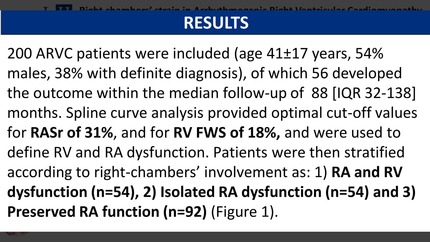
A total of 200 ARVC patients were included (age 41 ± 17 years, 54% males, 38% with definitive diagnosis). During a median follow-up of 88 [IQR 32-138] months, a total of 56 patients experienced the combined outcome. Through spline curve analysis, optimal cut-off values for RASr of 31%, and for RV FWS of 18% were identified and used to define RV and RA dysfunction. Patients were therefore stratified according to the level of right-chambers’ involvement into: 1) RA and RV dysfunction (n=54), 2) Isolated RA dysfunction (n=54) and 3) Preserved RA function (n=92). Patients with RA and RV dysfunction were older, more symptomatic, more often met definite ARVC criteria, and more often had an ICD. By echocardiography, RA and RV size and function were significantly worse in this group as well (Figure 1). In addition, left-chambers’ involvement was defined as either LA, LV or both left-chambers impaired function (based on literature-proposed cut-off values), and was also more frequent in patients with RA and RV dysfunction. Patients with isolated RA dysfunction and RA and RV dysfunction showed worse outcomes (p<0.001; Figure 2). At the multivariable Cox regression analysis, the RA-RV function groups were independently associated with outcome [Isolated RA dysfunction HR 2.74 (1.12- 6.72), p= 0.028; RA and RV dysfunction 4.33 (1.81- 10.33), p= <0.001] after correcting for age, sex, ARVC diagnosis and left-chambers’ involvement.
In ARVC patients, RA dysfunction is frequent and often combined with RV dysfunction. A combined assessment of RA and RV strain may help risk stratifying patients with ARVC. Baseline Characteristics Kaplan-Meier Survival Analysis
Contributors


M P Lopez-Santi
Author
D Laenens
Author
C Sarrazyn
Author
M Bootsma
Author
D Q C M Barge-Schaapveld
Author
J J Bax
Author
N Ajmone-Marsan
Author
You may be interested in