Impairment of right ventricle pulmonary artery coupling in beta thalassemia and sickle cell disease
European Heart Journal


Abstract
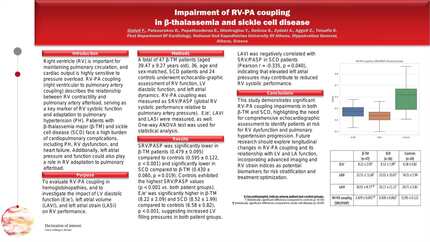
Right ventricle (RV) is important for maintaining pulmonary circulation, and cardiac output is highly sensitive to pressure overload. RV-PA coupling (right ventricular to pulmonary artery coupling) describes the relationship between RV contractility and pulmonary artery afterload, serving as a key marker of RV systolic function and adaptation to pulmonary hypertension (PH). Patients with β-thalassemia major (β-TM) and sickle cell disease (SCD) face a high burden of cardiopulmonary complications, including PH, RV dysfunction, and heart failure. Additionally, left atrial pressure and function could also play a role in RV adaptation to pulmonary afterload.
To evaluate RV-PA coupling in hemoglobinopathies, and to investigate the impact of LV diastolic function (E/e'), left atrial volume (LAVI), and left atrial strain (LASI) on RV performance.
A total of 47 β-TM patients (aged 39.47 ± 9.27 years old), 36, age and sex-matched, SCD patients and 24 controls underwent echocardiographic assessment of RV function, LV diastolic function, and left atrial dynamics. RV-PA coupling was measured as SRV/PASP (global RV systolic performance relative to pulmonary artery pressure). E/e', LAVI and LASI were measured, as well. One-way ANOVA test was used for statistical analysis.
SRV/PASP was significantly lower in β-TM patients (0.479 ± 0.095) compared to controls (0.595 ± 0.122, p < 0.001) and significantly lower in SCD compared to β-TM (0.430 ± 0.060, p = 0.019). Controls exhibited the highest SRV/PASP values (p < 0.001 vs. both patient groups). E/e' was significantly higher in β-TM (8.22 ± 2.09) and SCD (8.52 ± 1.99) compared to controls (6.58 ± 0.82), p < 0.001, suggesting increased LV filling pressures in both patient groups. LAVI was negatively correlated with SRV/PASP in SCD patients (Pearson r = -0.335, p = 0.040), indicating that elevated left atrial pressures may contribute to reduced RV systolic performance.
This study demonstrates significant RV-PA coupling impairments in both β-TM and SCD, highlighting the need for comprehensive echocardiographic assessment to identify patients at risk for RV dysfunction and pulmonary hypertension progression. Future research should explore longitudinal changes in RV-PA coupling and its relationship with LV and LA function, incorporating advanced imaging and RV strain indices as potential biomarkers for risk stratification and treatment optimization.
Contributors

D Patsourakos
Author
E Papatheodorou
Author
Y Dimitroglou
Author
S Delicou
Author
A Xydaki
Author
C Aggeli
Author
K Tsioufis
Author
You may be interested in